


Picture yourself in early October. You're pulling Q3 numbers together for a board deck or a quarterly review. You open Google Ads, look at performance by campaign, and something is off. Your prospecting campaigns look about 30% worse than they did in August. Your YouTube campaigns look like they stopped working entirely. Brand search, meanwhile, looks fantastic.
Nobody on your team touched anything. No budgets moved. No bids changed. The ads are the same ads.
What changed is the math Google uses to decide which campaign gets credit for a conversion. And if you don't know that happened, you're about to make some genuinely bad budget decisions based on it.
What Google actually changed
Two dates matter.
Starting in mid-July 2026, four attribution models stopped being selectable for any new conversion action: first click, linear, time decay, and position-based. If you tried to set one up after that point, the options were gone.
By September 2026, those four models disappear completely. Any conversion action still running one of them gets migrated to data-driven attribution automatically. There's no opt-out. There's no acceptance step. It happens on Google's schedule whether you engage with it or not.
When the dust settles, Google Ads has exactly two attribution models left: data-driven attribution and last click. That's the entire menu.

None of this is a surprise if you've been following it closely. Google first floated removing these models back in 2023, citing adoption below 3%. The deprecation has been rolling out in phases since then.
Which tells you something useful about who this actually affects. If your account is still on one of these four models in 2026, it's probably because somebody set it up once, years ago, and nobody has looked at it since. That describes a lot of accounts, including plenty that are spending real money every month.
Why this isn't a cosmetic change
Attribution models decide how credit gets split when someone touches more than one of your ads before converting. Different models split it very differently.
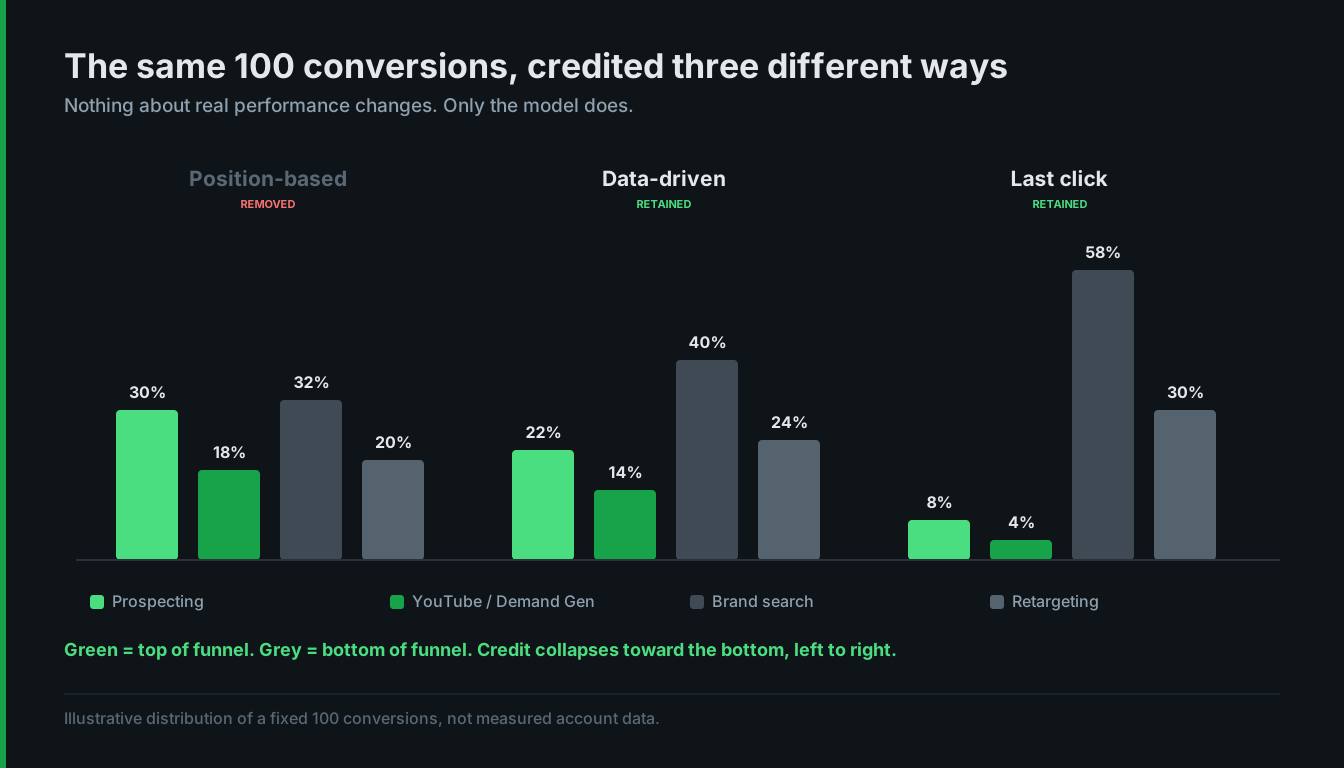
Position-based gives 40% of the credit to the first interaction and 40% to the last, with the remaining 20% spread across everything in between. Linear splits it evenly across every touchpoint. Last click hands 100% to the final click and nothing to anything that came before it. Data-driven uses Google's own modeling to distribute credit based on patterns it observes in your account.
Same conversions. Same customers. Same real-world performance. Wildly different numbers on your campaign report.
So when the model changes underneath you, your reported cost per acquisition and return on ad spend move at the campaign level without anything real having happened.
The campaigns that lose the most are the ones that touch people early in their process. Prospecting. YouTube. Demand Gen. Broad discovery campaigns. Anything whose job is to introduce you to someone who wasn't looking for you yet.
The campaigns that gain are the ones sitting at the end of the journey. Brand search. Retargeting. The campaigns that catch people who were already on their way to you.
Here's why that matters more than it sounds. If you make October budget decisions off October numbers, you will cut the campaigns that create demand and pour money into the campaigns that harvest it. That feels data-driven. It's the opposite of it. You'll be optimizing toward a smaller and smaller pool of people who already knew about you, and wondering in six months why growth stalled.
The part nobody is telling you: data-driven attribution needs volume
Data-driven attribution sounds like a straightforward upgrade. Machine learning instead of a fixed rule. Who wouldn't want that?
The catch is that it needs data to learn from. Google generally wants a conversion action to clear somewhere around 300 conversions in a trailing 30-day window before the model has enough signal to produce output you can rely on.
Sit with that number for a second, because it's larger than it looks. Three hundred conversions a month means roughly ten a day, every single day. At a $150 cost per acquisition, that's $45,000 a month of spend pointed at one conversion action.

Now run your own numbers. A business spending $10,000 a month with a $200 cost per lead generates about 50 conversions. A $25,000-a-month account at a $175 CPA lands around 140. Both are healthy, well-run accounts. Neither is anywhere close to 300 on a single conversion action.
Below that threshold, data-driven attribution doesn't fail loudly. That's the problem. It produces numbers that look sophisticated and authoritative, with decimal places and everything, built on a sample too thin to support them. Nobody questions a number that looks precise.
So the accounts getting migrated automatically are, disproportionately, the accounts least equipped to use the model they're being migrated into.
This is a pattern, not an incident
Google isn't alone in narrowing how credit gets assigned this year.
In January 2026, Meta permanently removed the 7-day and 28-day view windows from its Ads Insights API. Accounts that had been leaning on those longer windows saw reported conversions fall by an estimated 15% to 30%, according to industry analysis of the change.
In March, Meta narrowed what counts as a click-through conversion. Likes, shares, and saves stopped triggering the 7-day click window. Link clicks only.
Stack those against Google's September migration and the shape of 2026 becomes clear. Platforms are simplifying measurement on their own timelines, reported numbers move without real performance moving, and advertisers can't independently audit the model doing the deciding.
To be fair about it: every one of these changes came with a public announcement and a stated rationale. Nobody is being deceived. The issue is narrower than that, and more practical. You have no way to check the platform's work, and the platform keeps changing how it grades itself.
What to check before September
This is a 30-minute job, not a crisis. Here's the order I'd do it in.
Open the Attribution section. In Google Ads, go to Tools, then Attribution. Write down which model every single conversion action is currently using. Most people are surprised by at least one.
Pull trailing 30-day conversion volume for each action. Compare each one against roughly 300. You're not looking for a pass or fail so much as a sense of which actions have real data behind them and which don't.
Sort into three buckets. Actions comfortably above 300 will migrate fine. Actions well below it are going to produce distorted campaign-level numbers. Your primary revenue action deserves scrutiny no matter which side of the line it falls on.
Annotate the migration date wherever you report from. Looker Studio, a spreadsheet, whatever you use. Drop a note on the date so that when someone compares October to August in three months, the model change is visible instead of invisible. This single step prevents most of the bad decisions.
Don't compare September to August cold. Give it a few weeks to settle before you draw any conclusion at all. Reallocating budget in the first two weeks after a model change is how you talk yourself into a mistake.
Consider consolidating low-volume conversion actions. If you have four separate actions each generating 40 conversions, one combined action at 160 is closer to usable than any of them individually. Be honest about the tradeoff: you lose the ability to see those conversion types separately in bidding. Sometimes that's worth it. Sometimes it isn't.
If any of this surfaces the deeper question of whether your conversion tracking is telling you the truth in the first place, that's worth a separate audit of your conversion tracking before you worry about which model sits on top of it. A model applied to bad data produces confident nonsense.
The real fix is a number Google doesn't control
Step back from the specifics for a moment. If a change Google makes to its own reporting can move your performance numbers overnight, then your measurement depends on which model a platform happens to prefer this quarter. That's a fragile place to run a business from.
The alternative isn't complicated, and it doesn't require enterprise tooling. At mid-market scale it usually looks like two things.
First, a blended number you define yourself. Total marketing spend divided by total new customers, or total new revenue, tracked monthly. It's crude. It ignores the funnel entirely. Its great virtue is that nobody outside your building gets to redefine it. When Google changes a model, your blended number doesn't move, because it never depended on Google's opinion in the first place.
Second, revenue attribution that lives in your CRM rather than in the ad platform. Which leads closed, what they were worth, how long they took. This is the layer that survives every platform change, because it's built on what actually happened to your business rather than on which click got tagged. If you haven't connected that data back yet, closed-loop lead tracking is where to start.
Set expectations honestly with whoever you report to: platform numbers and blended numbers will never agree, and they aren't supposed to. Platform data helps you optimize inside a channel. Blended data helps you decide between channels. Trying to force them to match is a waste of a good afternoon.
The strongest version of independent measurement is a controlled test, where you deliberately withhold spend in some markets and measure the difference in outcomes. That deserves its own article, and it's coming.
Bottom line
Four attribution models are gone. By September, the migration finishes whether you participate or not. Two things are worth doing this month: spend half an hour checking which of your conversion actions have the volume to support data-driven attribution, and annotate the date in your reporting so October doesn't get misread as a performance collapse.
Then resist the urge to cut your top-of-funnel campaigns in the fall based on numbers that moved for reasons that had nothing to do with them. That's the mistake this change is going to cause most often, and it's entirely avoidable.
If you'd rather not audit this yourself, or you want a second read on whether your reported numbers reflect what's actually happening in your business, that's a conversation worth having. You keep the findings either way.
