

Let's start by granting the objection, because it's a good one.
Google handles roughly 90% of global search. Microsoft Advertising holds about 5%. Google captures around 62% of all global paid search revenue. If you only have the time, budget, or patience to run one search channel, it's Google, and nobody serious argues otherwise.
So most advertisers look at 5% and stop reading. That's the wrong place to stop, and here's why.
Once you're spending $5,000 a month or more, you're usually not choosing between one channel and another. You're deciding where the next dollar goes. And the honest answer is that adding a tenth click to an already-saturated Google account sometimes returns less than the first click in a cheaper auction full of a different kind of person.
Sometimes. Not always. This post is about telling those cases apart.
The numbers, straight
Average cost per click on Microsoft Ads runs around $1.54, roughly 33% to 40% below Google.
The gap is much wider in some verticals than others. In finance, Microsoft averages about $1.82 against Google's $3.44. In legal, it's roughly $1.42 against Google's $6.75, which is close to a five-to-one difference. Across all industries, Microsoft CPCs range from about $0.75 in careers and employment up to $2.88 in real estate.
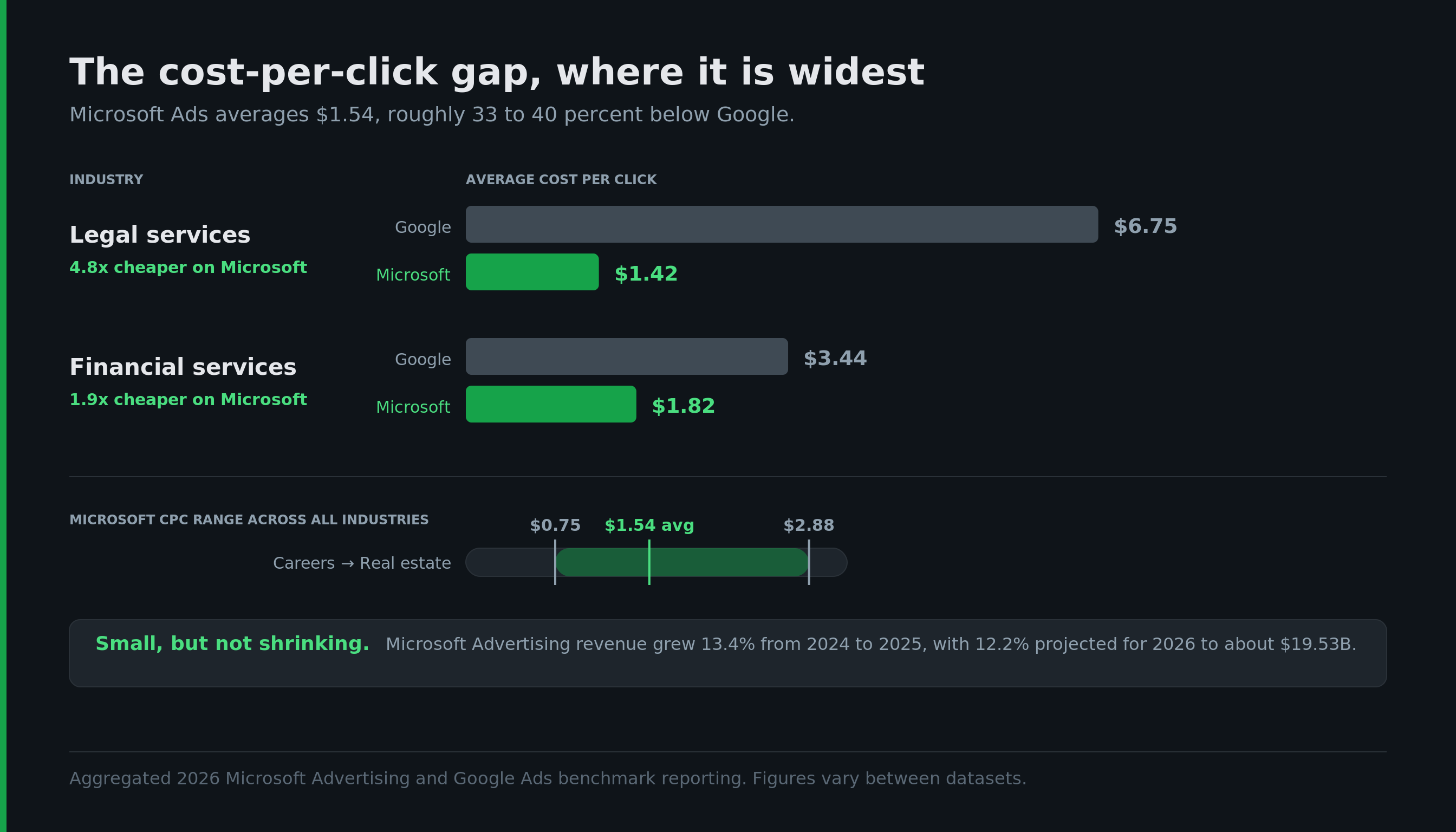
On the question of whether the platform is dying, which comes up in every one of these conversations: Microsoft Advertising revenue grew 13.4% between 2024 and 2025, and is projected to grow another 12.2% in 2026 to about $19.53 billion. Small, but not shrinking.
Who's actually on the other end
This is the real argument, and it isn't about volume at all.
The average Bing user is around 45 years old. The average Google user is around 38. That seven-year gap sounds minor until you consider what it means for specific products.
Roughly 38% of Bing users live in households earning over $100,000 a year. About 58% of US Bing users fall in the upper socioeconomic bracket. And in the 45-to-64 age group specifically, Microsoft's effective US market share is around 12.4%, well above its overall average.
Gender split is close to even, about 53% male and 47% female, which is comparable to Google. No meaningful difference there, and anyone telling you otherwise is stretching.
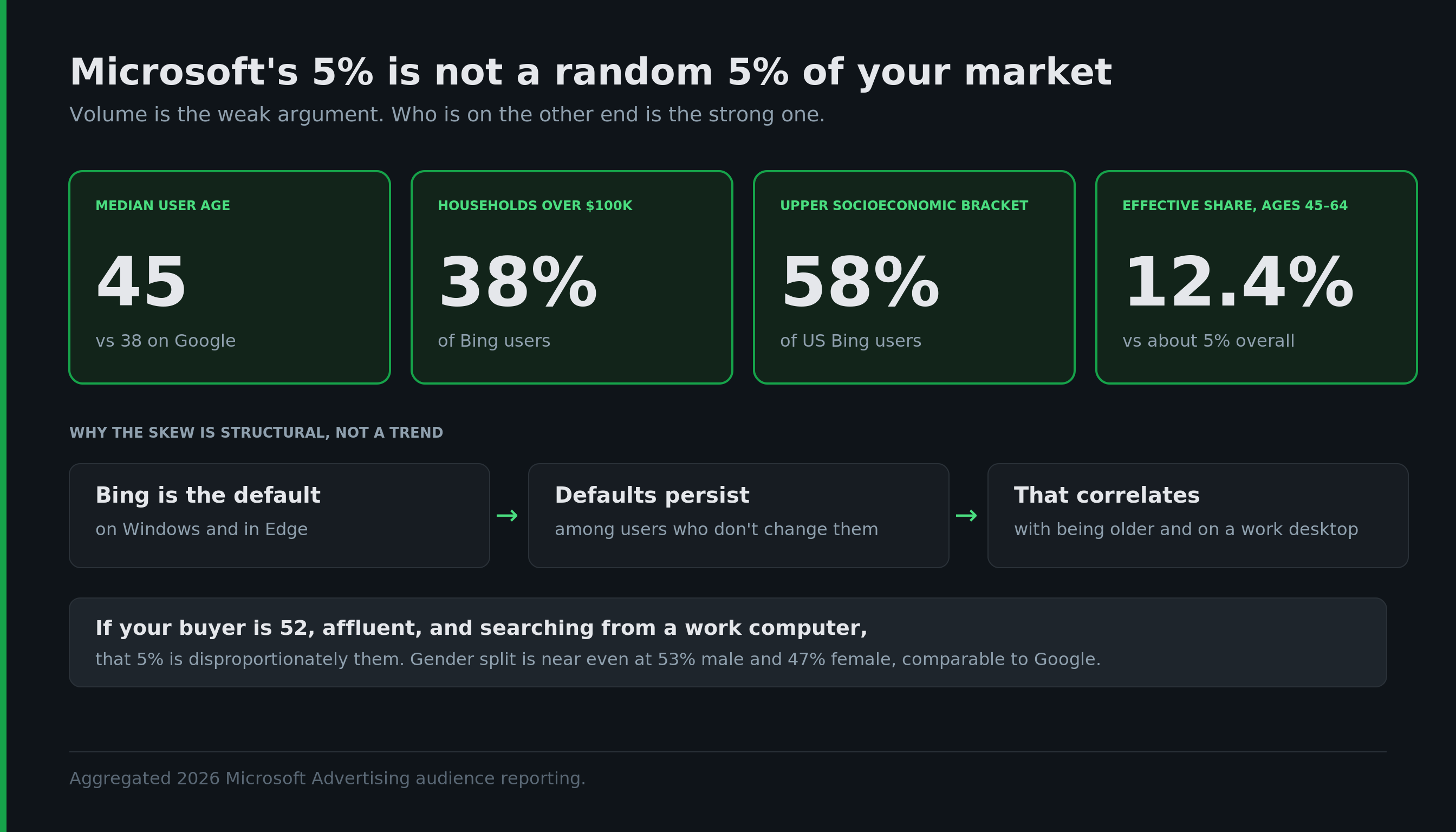
It's worth understanding why the skew exists, because it tells you whether it's durable. Bing is the default search engine on Windows and in Edge. Default-driven usage concentrates among people who don't change defaults, which correlates with being older and with working on a corporate desktop that IT configured. That's a structural reason, not a trend, which is why the demographic gap has held for years.
The practical implication: Microsoft's 5% is not a random 5% of your market. If your buyer is 52, affluent, and searching from a work computer, that 5% is disproportionately them.
The B2B advantage almost nobody uses
Microsoft owns LinkedIn. That means Microsoft Ads can layer LinkedIn professional signals, things like company, industry, and job function, onto search campaigns.
Think about why that combination is unusual. LinkedIn Ads gives you professional identity without purchase intent, because you're interrupting someone scrolling a feed. Google gives you intent without identity, because you know what they searched but not who they are. Microsoft can give you some of both at once: a person actively searching for what you sell, filtered by whether they hold the job title that buys it.
For mid-market B2B, the low-risk way to use this is as bid modifiers layered onto keywords you're already bidding on, rather than building targeted-only campaigns from scratch. You get a read on whether the professional signal correlates with conversion before you commit budget to it.
Two honest limits. Match rates are partial, not universal, so treat this as bid shaping rather than precision targeting. And availability varies by campaign type, so confirm what's actually available in your account before building a strategy around it. Third-party articles routinely oversell this feature.
Microsoft's broader first-party data position includes LinkedIn signals alongside Microsoft 365 usage data and Windows telemetry, which is a genuinely unusual asset for a platform this size.
What's new in 2026
A few things worth knowing if you last looked at this platform a couple of years ago.
Microsoft has rolled out AI Max, built for a search environment where queries are getting longer, more conversational, and increasingly happening on AI surfaces rather than a traditional results page.
Ads now appear inside Copilot responses. Offer Highlights surfaces product details like free shipping directly within Copilot conversations, running as part of the response flow. At announcement this was scoped to retail use cases in English-speaking markets across Copilot, Edge, and Bing.
Performance Max on Microsoft now combines search, audience network, and Copilot placements into a single campaign type, with new Customer Acquisition Goals oriented around incrementality, updated exclusion and targeting controls, and an experiments framework.
There's also Copilot-powered root cause analysis for diagnosing performance problems and conversion tracking issues, which is a genuinely useful addition given how often tracking is the actual problem.
The strategic read, stated carefully because this is a prediction and predictions are cheap: Microsoft is positioning inside AI assistant surfaces more aggressively than its search share would suggest it should. Whether that pays off depends on whether people keep shifting research behavior into AI assistants. It's worth watching rather than betting on.
Where it genuinely works
Strong fit:
Legal. The CPC gap approaches five to one. Even at a somewhat worse conversion rate, the arithmetic usually still works.
Financial services and insurance. Audience age and household income line up directly with the product.
B2B services with defined buyer titles. The LinkedIn layer is the differentiator, and this is where it earns its keep.
Healthcare, especially Medicare-adjacent services and elective procedures. The demographic skew matches the buyer almost exactly.
Home services in established suburbs. Homeowner age correlates with the platform's user base.
Enterprise software and IT. Corporate desktops default to Edge and Bing, and your buyer is sitting at one.
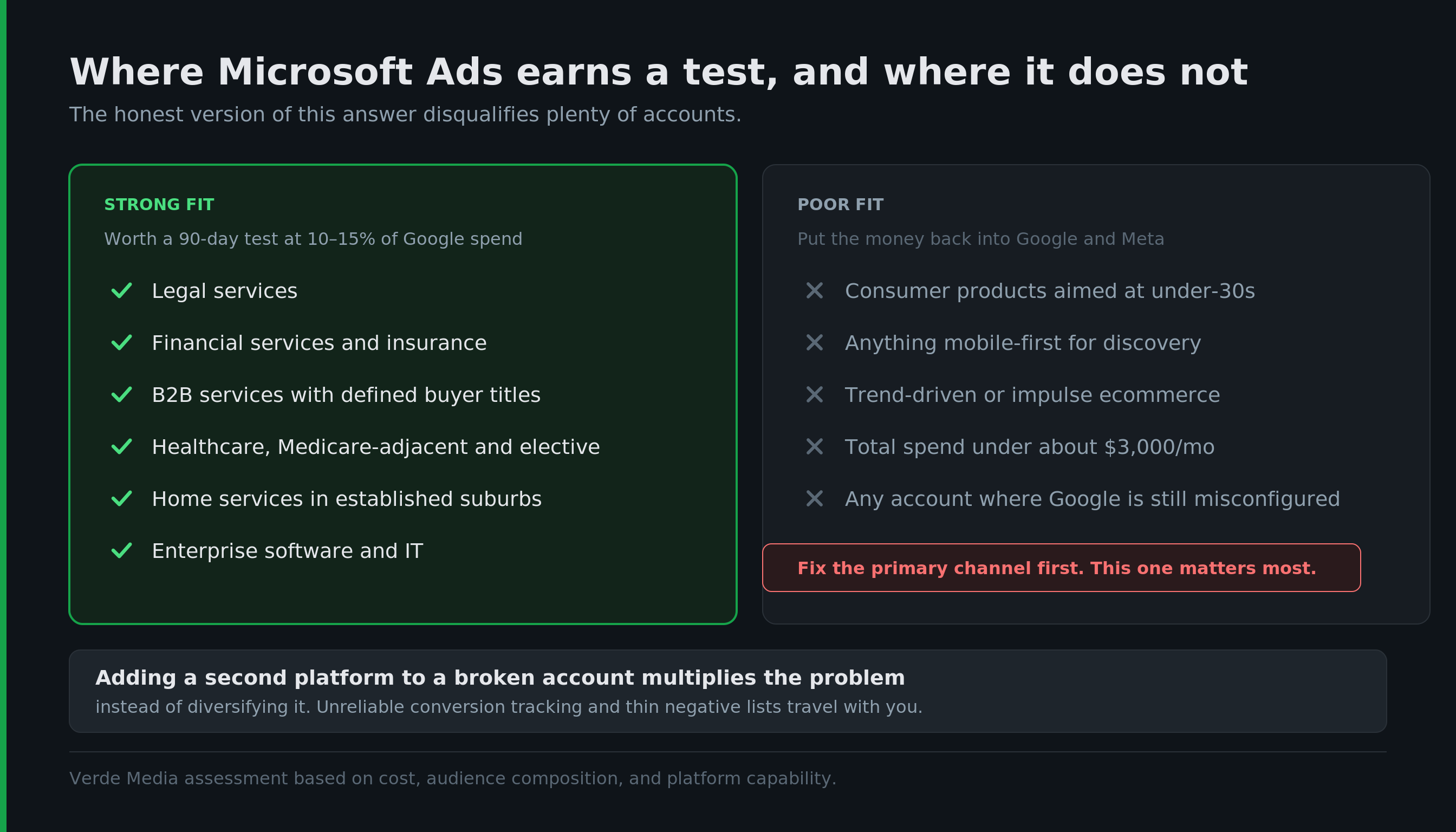
Poor fit, and it's more useful to say this plainly than to pretend everything works:
Consumer products aimed at people under 30. Anything dependent on mobile-first discovery, since Microsoft's share is heavily desktop-weighted. Trend-driven or impulse ecommerce. Accounts under about $3,000 a month total, where splitting budget across two platforms starves both.
And the one that matters most: any account where the Google side is still misconfigured. If your conversion tracking is unreliable, your negative keyword lists are thin, or your campaign structure is a mess, adding a second platform multiplies the problem instead of diversifying it. Fix the primary channel first. That's the honest answer even though it's the one that delays the new project.
Running it without doubling your workload
The real objection to a second channel is time, not money. Here's how to keep it manageable.
Import from Google rather than rebuilding. Microsoft's import brings over campaigns, ad groups, keywords, and copy, and you can set it to sync on a schedule. Rebuilding from scratch is the single biggest waste of time in this whole exercise.
Then deliberately break the sync where it matters. Imported accounts underperform mostly because nobody adjusts them afterward. Set bids independently. Google bids applied inside an auction that's 35% cheaper will either overpay or leave volume on the table, and usually both in different campaigns.
Build the negative keyword list separately. Search behavior differs between the platforms. Copying your entire Google negative list across on day one will block traffic that would have converted. Let it accumulate its own data first, then mine it. Our take on match types and negative keywords applies here too, with the caveat that you're starting from a blank slate.
Budget 10% to 15% of your Google spend, and commit to 60 to 90 days. Below that allocation you won't generate enough data to read the result.
Give it a genuine read window. Lower volume means longer time to significance. Judging at 30 days is the most common way a perfectly good Microsoft test gets killed.
Watch the UET tag closely. Microsoft's conversion tracking is a separate implementation from your Google tags, and a broken or missing UET tag is the number one reason a Microsoft test looks like a failure when it isn't. Verify it before launch, then verify it again a week in. If you want the general method, our guide to auditing conversion tracking transfers cleanly.
Realistic ongoing time cost once it's running and stable: a few hours a month, provided you resist the urge to manage it like a separate business.
Bottom line
Microsoft Ads is a legitimate 10% to 15% budget allocation for the right vertical and a distraction for the wrong one.
If you're in legal, finance, insurance, B2B services, healthcare, or enterprise IT, and your Google account is already in good shape, the cheaper auction and the older, wealthier audience make a 90-day test worth running. If you're selling to 25-year-olds on their phones, skip it and put the money back into Google and Meta.
Not sure which side of that line you're on? We'll look at your Google account first. If that's where the remaining opportunity actually is, we'll tell you, and the Microsoft conversation can wait. You can also read more about how we handle paid search and social ads across platforms.
