


Pull up almost any Google Ads account and the brand campaign is the best thing in it. A $1.40 cost per click. An 18% conversion rate. A return on ad spend somewhere north of 9x. Every other campaign looks worse by comparison, and every quarterly review spends a few minutes admiring it.
Here's the question that almost never gets asked in that meeting: how many of those people were going to buy anyway?
Someone who searches your company name already knows who you are. They trusted you enough to type your name into a search box. Some of them would have clicked your organic listing, which is free, if your ad hadn't been sitting above it. You paid for a visitor you already had.
The share of brand clicks that fall into that bucket isn't zero and it isn't most. And in Q4, when brand cost per click rises with everything else and competitors start bidding on your name, the question stops being academic.
So let's answer it. Then let's talk about why we bid on brand anyway, and where the real waste in brand spend actually hides, because it's usually not where people look.
Why brand campaigns look so good
Start with the mechanics, without cynicism.
A person searching your brand name is deep in their decision. They've probably seen your ads before, read a review, maybe visited the site once already. Of course they convert. That's not the campaign being brilliant. That's the campaign catching people at the finish line.
Every attribution model then gives that brand click full or near-full credit, because it's the last click before the conversion. The model has no way to see the six weeks of prospecting ads, the referral, the podcast mention, or whatever else made them search your name in the first place. We wrote about this in July: attribution describes credit, not cause, and brand search is where that distinction bites hardest.
So brand campaigns aggregate credit from everywhere else in your marketing and report it as their own. That's not a flaw in your account. It's how attribution works. But it means the 9x ROAS isn't measuring what the campaign caused. It's measuring where the journey ended.
What a brand campaign is actually buying
Break a hundred brand-term conversions into three groups.
Some needed the ad. The searcher was undecided, or comparing you to two competitors, or would have bounced off a mediocre organic result. The ad, with its sitelinks and current offer and controlled message, closed it.
Some would have converted organically. They typed your name, they were going to click the first result with your name on it, and the ad happened to be that result. Microsoft's own research on brand bidding puts this group at 11% to 18% of brand ad clicks.
And some were defended. A competitor is bidding on your name. Without your ad, the top result for your company name would have been theirs. This group is invisible in your reporting and it's the whole reason the campaign exists.
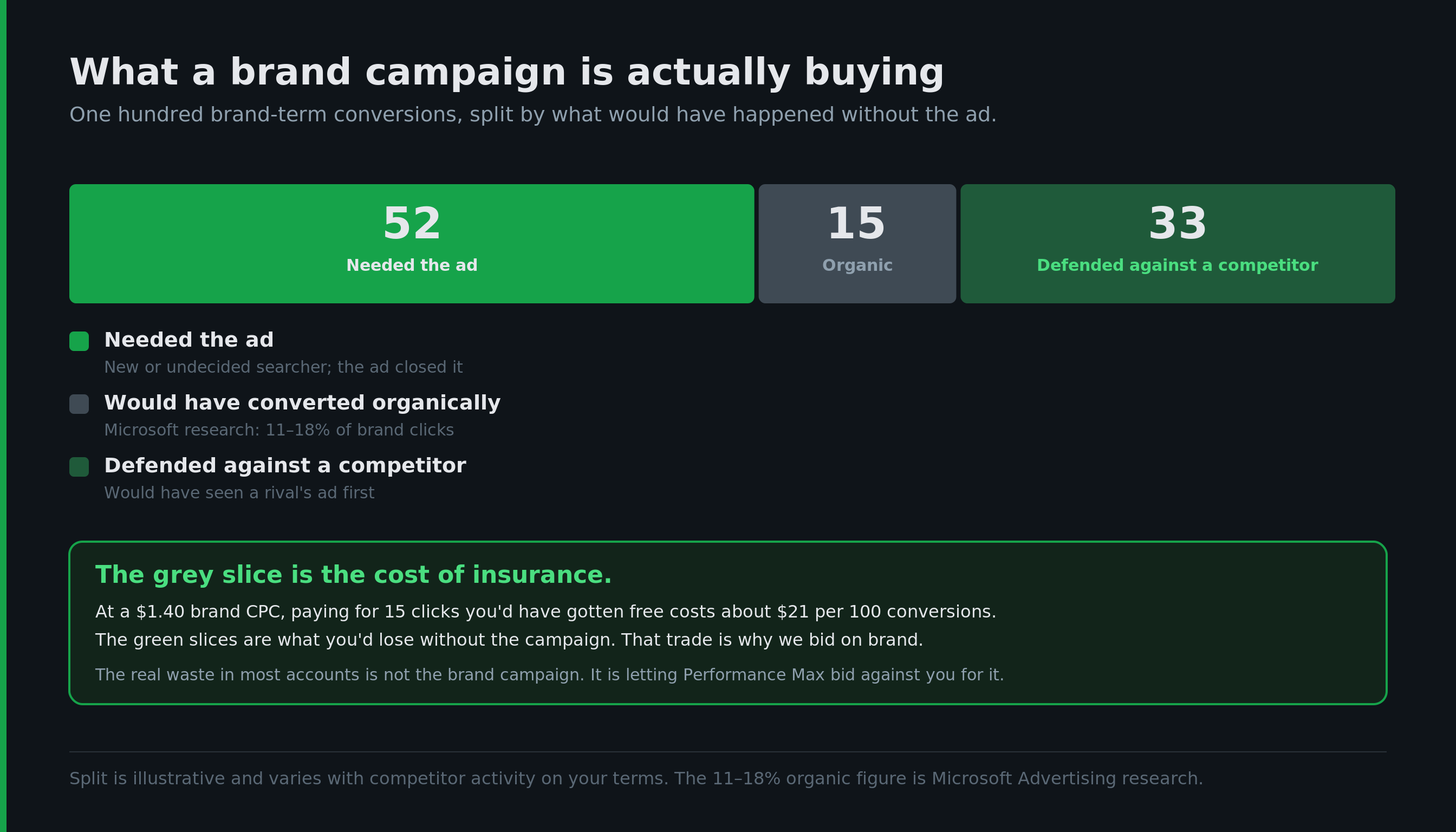
Run the numbers on the middle group. At a $1.40 brand CPC, paying for 15 clicks you'd have gotten for free costs about $21 per hundred conversions. That's the cost of insurance. It's small. And the two green groups on either side of it are what you'd lose if you stopped paying it.
This is why we bid on brand. Not because the ROAS is real, but because the alternative is worse.
The three reasons to bid on your brand anyway
Competitors are on your name. This is the strongest argument and it's a defensive one. If a competitor is bidding on your brand and you aren't, the top result for your own company name is someone else's ad. Competitor campaigns are among the most expensive campaign types in Google Ads, and they spike in Q4. The person searching your name in Black Friday week is exactly who your competitor wants to intercept.

You control the message. Your organic listing says whatever Google decides to pull from your page. Your ad says what you want it to: the current promotion, the right landing page for the season, sitelinks to pricing and contact and the thing you're pushing this month. In Q4, with a live offer, that control has real value, and it costs $1.40 a click.
It's cheap. Brand clicks are the least expensive clicks you'll ever buy. Even if a third of them were unnecessary, the total waste is a rounding error next to a single misconfigured non-brand campaign. The people who spend energy trying to eliminate brand waste are usually optimizing the smallest line in the account while the big ones go unexamined.
So the house position is simple: bid on your brand. Then make sure you're doing it in a way you can actually see, because that's where the real problem lives.
Where the waste actually is
The brand campaign itself is rarely the waste. These three things are.
Performance Max is bidding on your brand for you
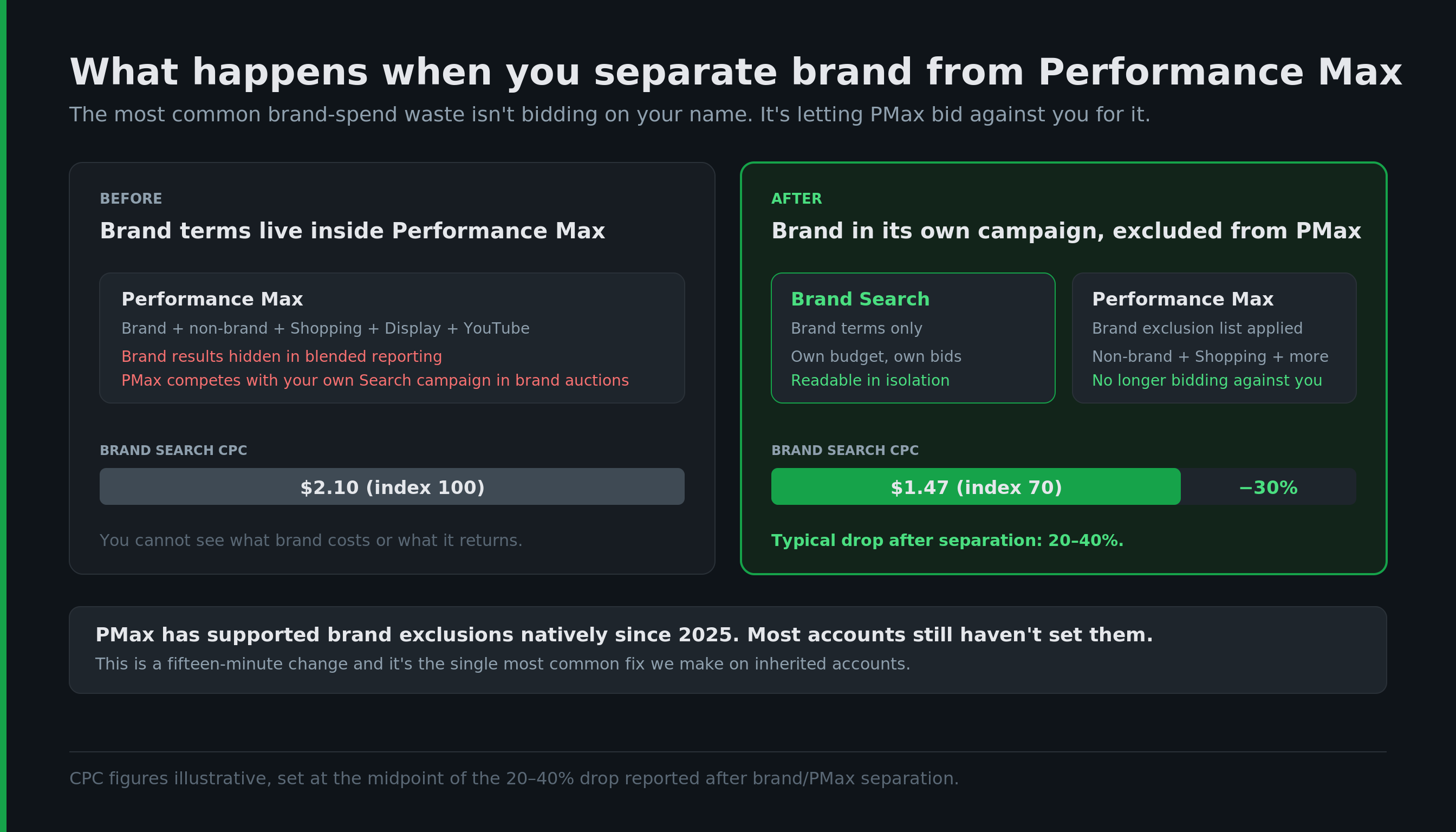
If you run Performance Max and haven't excluded your brand terms from it, PMax is bidding on your company name right now. You can't see it, because PMax reporting blends everything together. And it's competing against your own Search campaign in your own brand auction, which drives up the cost of both.
Separate brand into its own Search campaign and add your brand terms to a PMax brand exclusion list. Brand Search CPC typically drops 20% to 40% afterward, because PMax stops bidding against you. Google has supported brand exclusions in PMax natively since 2025. It takes about fifteen minutes to set up. It's the single most common fix we make on accounts we inherit, and it's almost never been done.
Brand and non-brand share a campaign
When brand and non-brand keywords sit in the same campaign, you can't read either. The brand terms make the campaign look efficient, the non-brand terms make it look expensive, and the blended number tells you nothing about what to do. Smart Bidding, working from that blended signal, tends to lean into the brand terms because they convert, and starve the non-brand terms that are doing the actual work of finding new customers.
Split them. One brand campaign, one or more non-brand campaigns, separate budgets, separate bid strategies. This is the most common structural mistake in mid-market accounts and it's usually inherited from whoever set things up in 2021.
Q1 decisions made off Q4 brand ROAS
This one is seasonal and it's the reason this article runs before Q4 starts.
Brand CPCs inflate in Q4 along with everything else, so the brand campaign spends more. Q4 intent is higher, so it converts even better than usual. And all the extra non-brand and prospecting spend you added for the holidays creates more people who search your name in December, all of which gets attributed to the brand campaign.
Result: in January, someone opens the Q4 report, sees brand at 12x ROAS and prospecting at 2x, and cuts prospecting. Then brand volume drops in Q2, nobody connects the two events, and the account spends the rest of the year shrinking.
Guard against it before it happens. Report brand and non-brand as separate lines in Q4. Annotate the reporting so anyone reading it in January sees the split. And write the rule down now: no Q1 reallocation decisions based on Q4 brand ROAS.
What to do this month
Before November, when brand CPCs rise and competitors start conquesting in earnest.
1. Split brand into its own campaign if it isn't already. Own budget, own bid strategy.
2. Exclude brand from Performance Max using a brand exclusion list. Then watch brand Search CPC over the following two weeks.
3. Check auction insights on your brand terms. Who's showing up on your name? Nobody, one competitor, three? This tells you how much the defensive argument is worth in your specific account, and it changes the answer.
4. Set the Q4 brand budget deliberately. Based on competitor presence and offer cadence, not on last quarter's ROAS.
5. Separate brand and non-brand in Q4 reporting. Two lines, clearly labeled, with an annotation that says why.
6. Write down the rule: no Q1 cuts to prospecting based on Q4 brand performance.
The one test that tells you for sure
Everything above is inference. There's exactly one way to actually know how much of your brand spend is defense and how much is insurance: turn it off in some markets and watch what happens to total brand-term conversions, paid plus organic, in those markets.
Brand campaigns are the ideal first geo holdout. High volume, clean signal, low risk. If you're only going to run one test, run this one. We laid out how to design a geo holdout earlier this month, including why you should wait until January to run it and not try it in Q4.
Set expectations: brand holdouts frequently come back somewhere between 30% and 70% incremental. That's a wide range and it's the honest one, because the number depends almost entirely on how many competitors are bidding on your terms. An account with three aggressive conquestors will test high. An account nobody's attacking will test low. Either way, you'll know, and the January budget conversation gets a lot shorter.
Bottom line
Your brand campaign looks like your best performer because attribution hands it credit for work done elsewhere. Some of that spend buys visitors who were already yours. That's the cost of insurance, and it's cheap. Bid on your brand.
Then fix the three things that actually waste brand money: get it out of Performance Max, split it from non-brand so you can read both, and don't let a flattering Q4 brand ROAS talk you into cutting the campaigns that made people search your name in the first place.
If you want a read on whether your brand spend is set up to be seen, or whether PMax is quietly bidding against you, that's a twenty-minute conversation. Bring your auction insights. And if you're curious how this fits into how we run paid search and social ads generally, that page covers the approach.
