


The Future of Search Just Knocked on My Door
Last week, I was researching marketing automation tools for a client. Out of habit, I typed my query into Google and started scrolling through the familiar list of blue links. Then I remembered: Google AI Mode.
I clicked over to the AI Mode tab and asked the same question: "What are the best marketing automation tools for small businesses under $200 per month?"
Instead of getting ten different website links to click through, I got a comprehensive breakdown comparing HubSpot, Mailchimp, ConvertKit, and others – complete with pricing, features, pros and cons, and even implementation timelines. All the information I needed was right there, with source links neatly organized in a sidebar if I wanted to dig deeper.
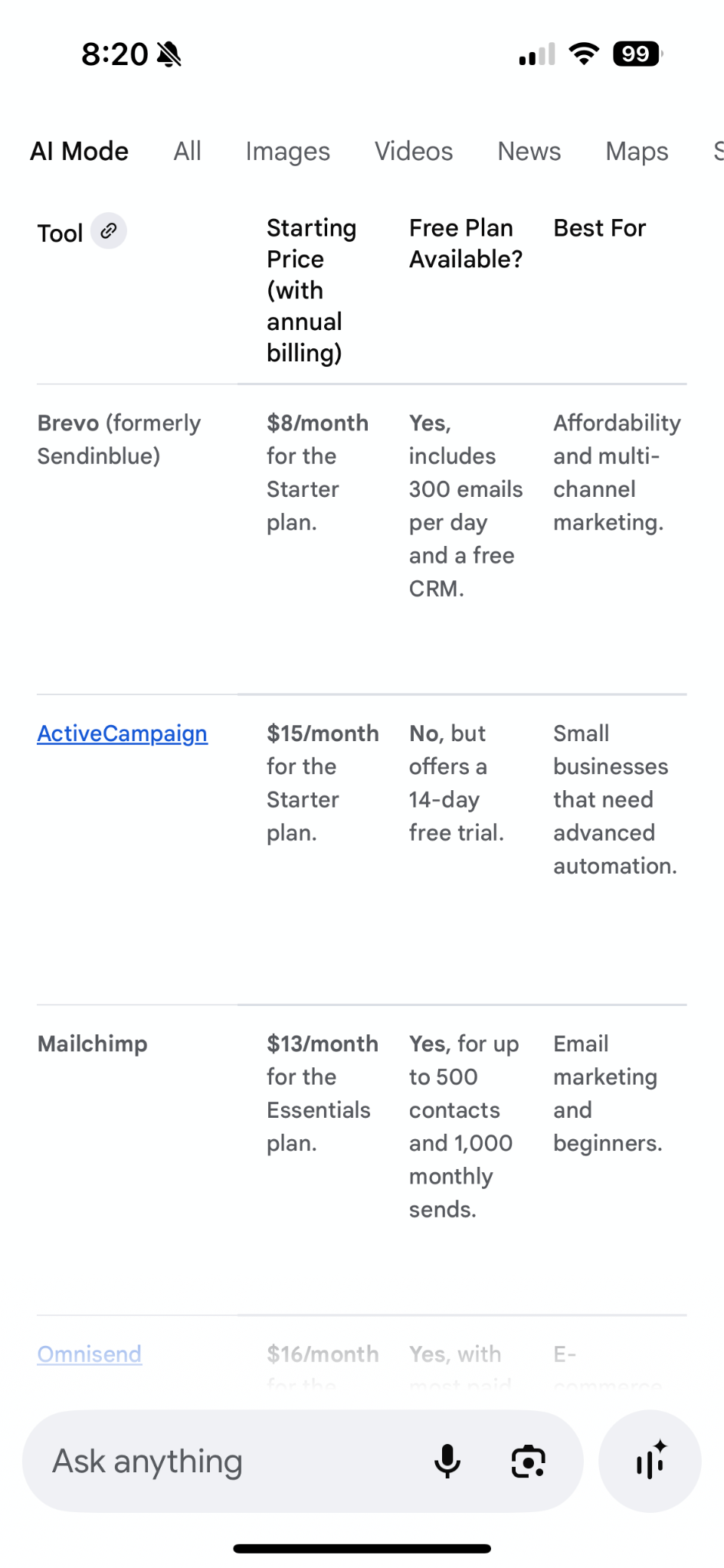
The kicker? I never left Google. I got my answer, made my recommendation to the client, and moved on. The websites I would have normally visited? They never got my click.
That moment made something very clear: this isn't just another Google feature. This is the beginning of a fundamental shift in how people find and consume information online.
And according to recent statements from Google executives, this shift might happen a lot sooner than we thought.
The Announcement That Changed Everything
Earlier this month, Logan Kilpatrick, Google's lead product manager, made a statement that sent shockwaves through the digital marketing world. When asked on X (formerly Twitter) if AI Mode would become the default Google search experience, his response was simple but powerful: "Soon."
Just to be clear about what we're talking about here: Google's AI Mode is "a new tab within Google Search that brings you into a more AI-like interface" that "is particularly helpful for queries where further exploration, reasoning, or comparisons are needed."
Now, Google VP Robby Stein did try to walk back some of the speculation, saying people shouldn't "read too much into this" and that Google is "focusing on making it easy to access AI Mode for those who want it." But here's the thing – Google's actions speak louder than their diplomatic statements.
Over the past few months, Google has been rapidly expanding access to AI Mode. They've rolled out AI Mode in 180 countries and territories after recently expanding AI Mode in the UK, India and the US. They've also created a direct shortcut at google.com/ai that takes you straight to AI Mode, bypassing traditional search entirely.
That's not the behavior of a company treating this as just another optional feature.
What Exactly is Google AI Mode?
Think of AI Mode as Google's answer to ChatGPT, but with access to the entire web and real-time information. Instead of giving you a list of websites to visit, AI Mode gives you direct, comprehensive answers to your questions.
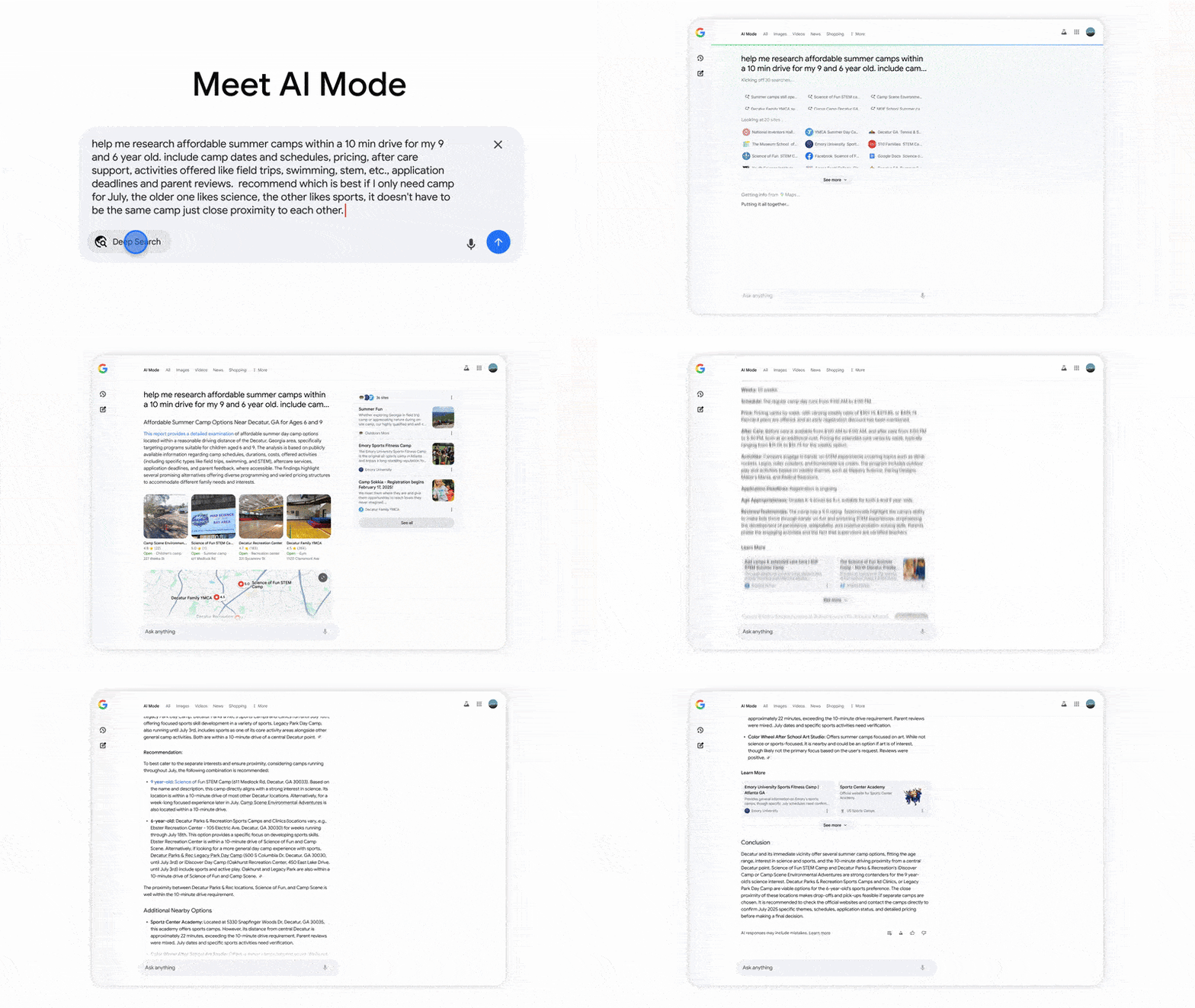
Here's how it works behind the scenes: AI Mode uses a "query fan-out" technique that issues multiple related searches concurrently across subtopics and multiple data sources and then brings those results together to provide a response. Essentially, Google is doing dozens of searches on your behalf, analyzing all the results, and synthesizing them into one comprehensive answer.
The interface itself is dramatically different from traditional Google search. When you use AI Mode, you're not looking at a page of blue links. Instead, you see:
- A large, central area with an AI-generated response
- A sidebar containing relevant links (typically around 7 unique domains)
- An input field at the bottom for follow-up questions
- The ability to continue the conversation, just like ChatGPT
The experience is conversational and interactive. You can ask follow-up questions, request clarifications, or dive deeper into specific aspects of your original query – all within the same interface.
How This Differs from Traditional Search
The difference between traditional Google search and AI Mode is like the difference between a library catalog and a personal research assistant.
Traditional Google Search:
- Presents a ranked list of 10 blue links
- You click through to different websites
- You piece together information from multiple sources yourself
- Success is measured by finding the right website
- Each search is independent
Google AI Mode:
- Provides a comprehensive, synthesized answer
- Information is presented directly in the search interface
- Sources are cited but you don't need to visit them
- Success is measured by getting complete information
- Supports conversational follow-ups
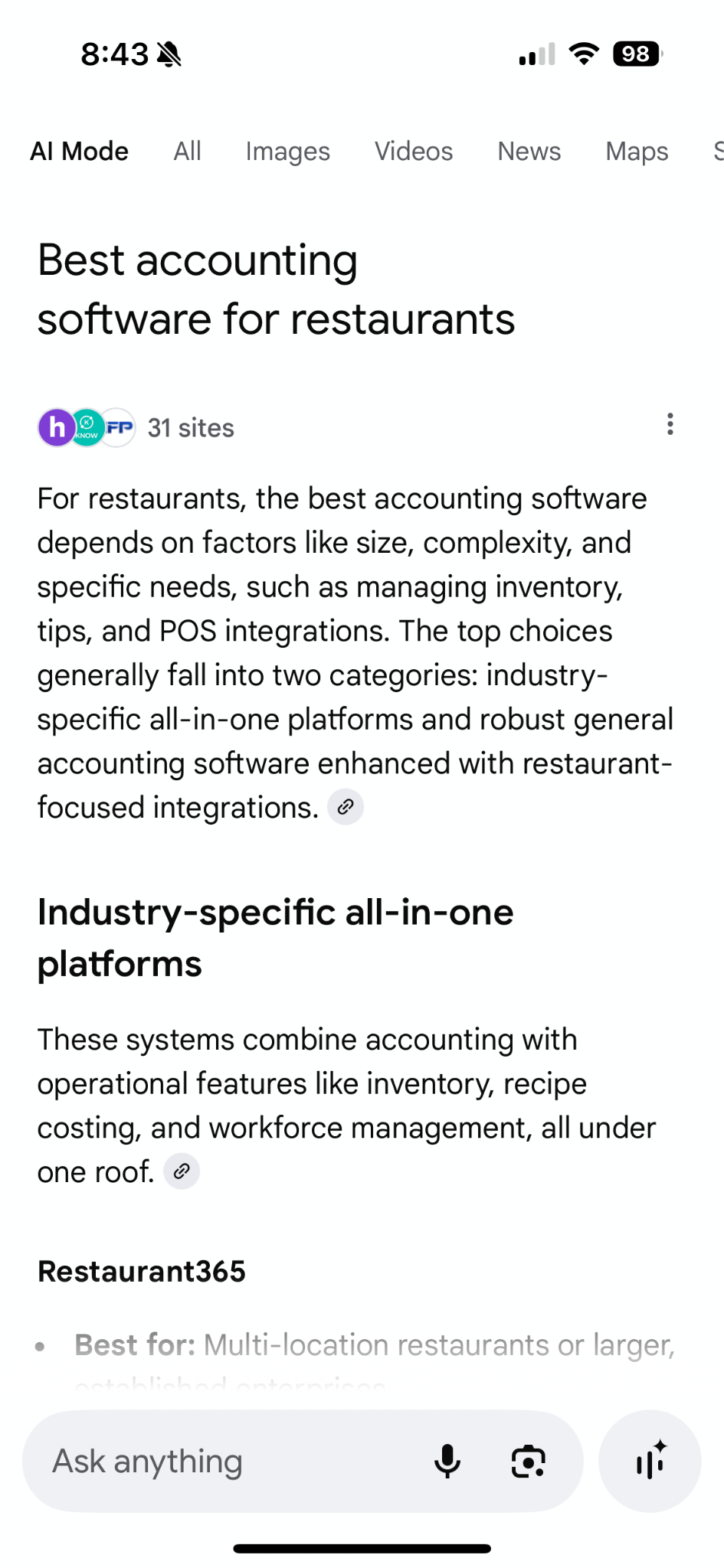
Here's a concrete example: If you search "best accounting software for restaurants," traditional Google gives you links to articles from various software review sites, individual product pages, and blog posts. You'd need to visit multiple sites, compare features yourself, and synthesize the information.
AI Mode, on the other hand, would analyze all those sources and present you with a comparison table, highlighting key features, pricing, and recommendations based on restaurant-specific needs – all without requiring you to leave Google.
The implications are staggering. In recent studies, researchers found that AI Mode queries are twice as long as traditional search queries, and 92% of AI Mode responses featured a sidebar showing around 7 unique domains, with only 51% domain overlap with Google's traditional top 10 search results.
This means AI Mode is not just reorganizing existing search results – it's finding and prioritizing different sources entirely.
The Broader Impact on Search Behavior
This shift represents more than just a new interface – it's fundamentally changing how people interact with information online.
The End of the "Click Journey"
For decades, the web has been built around the idea that search engines help people find websites to visit. The entire ecosystem – SEO, content marketing, web design, analytics – is built around getting people to click from Google to your website.
AI Mode threatens to break that chain. When Google provides comprehensive answers directly in the search interface, people have less reason to click through to websites. This isn't speculation – it's already happening.
Zero-Click Searches Becoming the Norm
We're moving toward a world of zero-click searches, where users get the information they need without ever leaving Google. This is similar to what we've seen with featured snippets and knowledge panels, but AI Mode takes it to an entirely new level.
Personalization at Scale
AI Mode responses are heavily personalized based on the user's search history, location, and preferences. This means two people searching the same term might see completely different AI-generated summaries and citations. This makes traditional rank tracking almost meaningless – there's no single "position" to measure anymore.
What This Means for Your Business
If you're a business owner, the implications of AI Mode becoming the default are significant and immediate.
Traffic Changes
The most obvious impact is on website traffic. If people are getting their answers directly from Google instead of clicking through to websites, many businesses will see a decrease in organic search traffic. This is especially true for informational content – blog posts, how-to guides, and educational resources that currently drive significant traffic.
However, it's not all doom and gloom. Google has noted that "when people click from search results pages with AI Overviews, these clicks are higher quality (meaning, users are more likely to spend more time on the site)." The clicks you do get may be more valuable.
New Success Metrics
Traditional SEO metrics like keyword rankings and click-through rates become less relevant in an AI Mode world. Instead, you'll need to focus on:
- AI Citation Frequency – How often your content appears as a source in AI Mode responses
- Brand Mention Quality – How your business is described and positioned in AI-generated answers
- Authority Recognition – Whether AI Mode positions you as an expert in your field
Visibility Without Rankings
In traditional search, you either rank on page one or you're essentially invisible. AI Mode changes this dynamic. Because AI Mode may use a "query fan-out" technique, issuing multiple related searches across subtopics and data sources, it can "display a wider and more diverse set of helpful links associated with the response than with a classic web search, enabling new opportunities for exploration."
This means businesses that might never have ranked #1 for competitive terms could still get visibility through AI citations.
How to Adjust Your Strategy Now
The good news is that many traditional SEO fundamentals still apply to AI Mode. Google explicitly states that "the best practices for SEO remain relevant for AI features in Google Search" and that "there are no additional technical requirements" to appear in AI Mode.
However, there are specific steps you should take to optimize for this new reality:
1. Focus on Authority and Expertise
AI systems prioritize authoritative, trustworthy sources. Ensure your website demonstrates clear expertise in your field through:
- Detailed author bios and credentials
- Citations and references to reputable sources
- Comprehensive, well-researched content
- Clear contact information and business credentials
2. Optimize for Direct Answer Format
Structure your content to provide clear, direct answers to specific questions. Use:
- FAQ sections that directly address common queries
- Step-by-step guides with numbered lists
- Summary sections at the beginning of longer articles
- Clear headings that match the questions people ask
3. Build Citation-Worthy Content
Create content that AI systems will want to reference and cite:
- Original research and data
- Comprehensive guides that cover topics thoroughly
- Regular updates to keep information current
- Multiple formats (text, images, videos) for the same information
4. Monitor Your AI Presence
Start tracking how your brand appears in AI-generated responses:
- Regularly search for your business in AI Mode
- Monitor mentions in AI responses for industry-related queries
- Track which of your pages gets cited most frequently
- Set up Google Alerts for your brand name in AI-related contexts
The Bottom Line: Adapt or Become Irrelevant
Here's the reality: whether AI Mode becomes the default search experience in six months or two years, the writing is on the wall. Google is investing heavily in AI-powered search, and user behavior is already shifting toward expecting direct, comprehensive answers rather than lists of links to explore.
The businesses that recognize this shift and start adapting now will be the ones that thrive in the new search landscape. Those who wait and hope things go back to "the way they used to be" will find themselves increasingly invisible to potential customers.
This doesn't mean traditional SEO is dead – far from it. It means SEO is evolving, and the fundamentals of creating valuable, authoritative content remain as important as ever. However, the way that content is discovered and consumed is changing rapidly.
The question isn't whether this change is coming – it's whether you'll be ready for it.
As Google continues to roll out AI Mode globally and makes it more accessible to users, the businesses that understand how to build authority, create citation-worthy content, and adapt to new success metrics will be the ones that maintain their competitive edge.
The search revolution is here. The only question is: will you lead it, or will you be left behind by it?
