

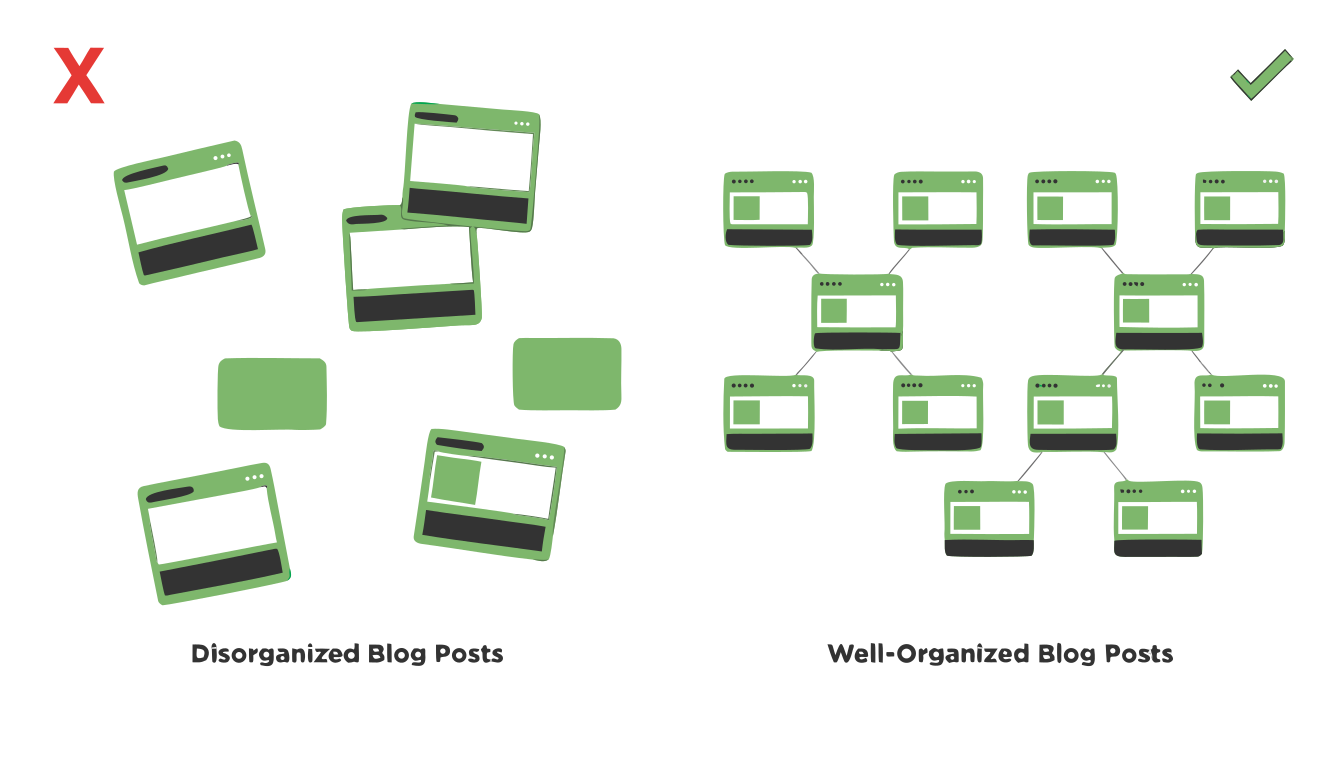
Most business websites grow the same way: someone decides they need a blog, so they start publishing. A post about industry trends. A post about a product feature. A post answering a customer question. Over a year or two, the blog section fills up with 40 or 50 posts that have no relationship to each other. They're just... there.
The posts might even be good individually. But they don't build on each other. They don't link to each other in any meaningful way. Google crawls them as 50 isolated pages, not as a body of expertise on any particular subject. And the business wonders why none of them rank.
This is how most companies approach content strategy, and it's why most company blogs produce almost no organic traffic. The content isn't bad. The structure is.
What hub-and-spoke actually means
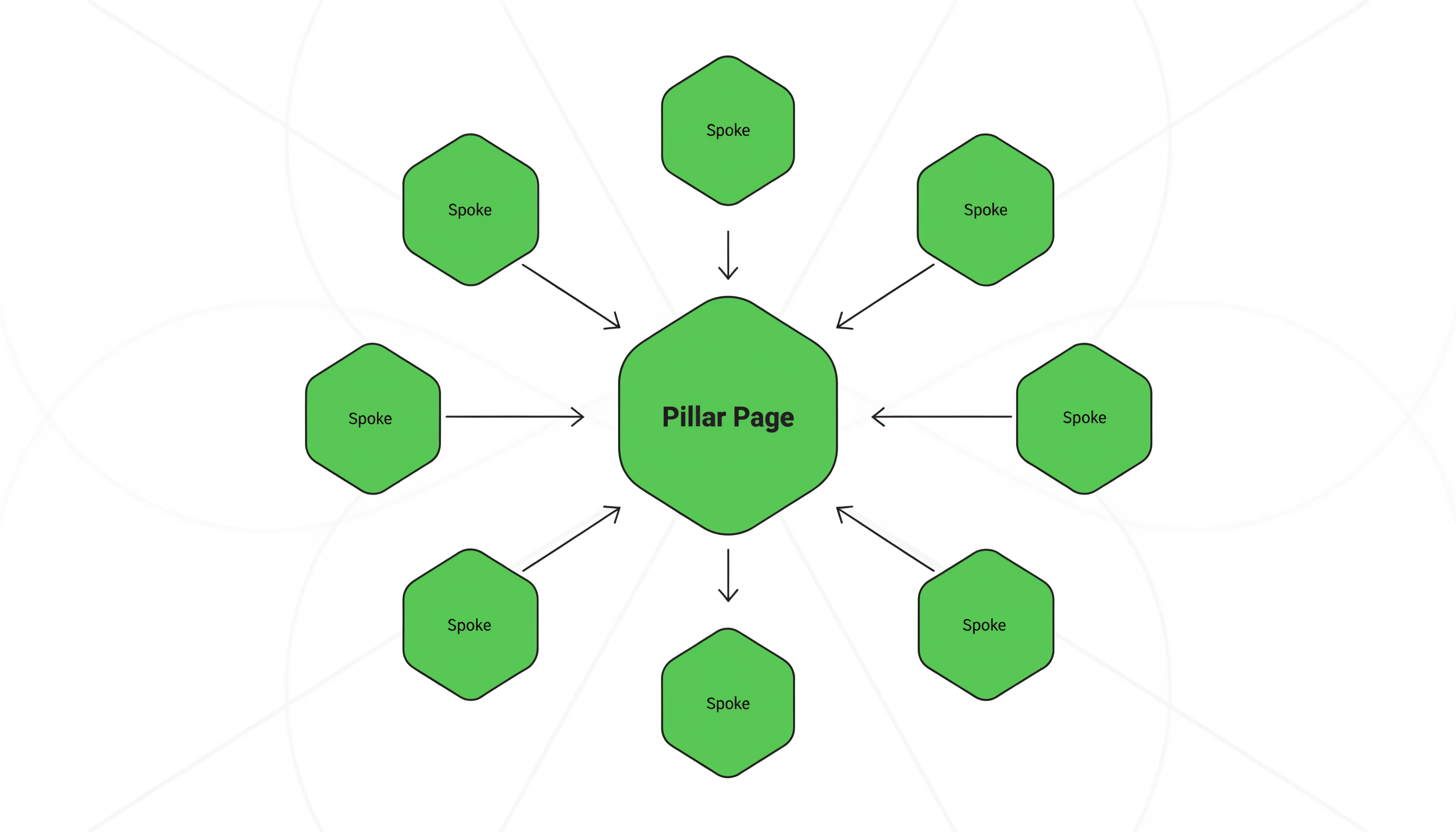
The concept is simpler than it sounds. You pick a broad topic your business should own in search. You build one comprehensive page about that topic (the hub, also called a pillar page). Then you build a set of more specific pages that each cover one subtopic in depth (the spokes). Every spoke links back to the hub. The hub links out to every spoke. The spokes link to each other where it makes sense.
That's it. The hub is the parent. The spokes are the children. They all point to each other.
The reason this works is that Google evaluates your site's authority on a topic partly by looking at how your content is organized and interlinked. A single blog post about "engineering staffing" sitting alone tells Google you mentioned the topic once. A pillar page about engineering staffing with ten spoke pages covering specific engineering roles, each linking back to the pillar, tells Google this is a subject you know something about. The interlinked cluster sends a stronger signal than any individual page could on its own.
Why random publishing doesn't work anymore
Google got better at understanding topics, not just keywords. The algorithm groups related queries together and looks for sites that cover a subject thoroughly. If someone searches "controls engineer staffing agency," Google doesn't just look for pages with those exact words. It evaluates whether your site demonstrates depth on engineering staffing as a whole.
A site with a strong pillar page on engineering staffing, plus dedicated pages on controls engineers, mechanical engineers, electrical engineers, robotics engineers, and process engineers, looks far more authoritative than a competitor with one generic "staffing services" page. Even if that competitor's page has better backlinks, the depth of your content cluster can tip the scales.
This is what people mean when they talk about "topical authority." It's not a mystery metric. It's the observable pattern that sites with organized, interlinked content on a specific subject tend to outrank sites with scattered, unconnected pages on the same subject.
How to pick your pillars
Start with what your business actually does and what your customers actually search for. Not what sounds good in a brainstorm. What people type into Google.
Run your core services through a keyword research tool (Semrush, Ahrefs, even Google's Keyword Planner). You're looking for topics where the combined search volume across the parent term and its subtopics is worth pursuing. The pillar keyword itself might only get 200 searches a month, but if there are 15 spoke keywords averaging 50-100 searches each, that cluster represents 1,000+ monthly searches that you can systematically capture.
A few guidelines for choosing pillars:
Pick topics you can genuinely go deep on. If you can't write 8-12 distinct spoke pages under a pillar, it's probably not broad enough to be a hub. It might work better as a spoke under a different pillar.
Align with revenue, not vanity. A pillar should map to a service line, product category, or vertical that makes you money. "Industry trends" might generate traffic, but "engineering staffing" generates leads.
Limit yourself. Most businesses need 3-7 pillar topics. You don't need 20. If you try to build too many clusters simultaneously, none of them get deep enough to rank. Start with the one that's closest to revenue and build it out completely before starting the next one.
We recently built an SEO strategy for a B2B staffing company in Metro Detroit. They serve five verticals: engineering, manufacturing, automotive, property management, and office/clerical. Each vertical became a pillar page. Under engineering alone, we mapped 10 spoke pages for specific roles (controls engineers, mechanical engineers, electrical engineers, robotics engineers, and so on). The manufacturing pillar got 14 spokes. The whole build was 5 pillars and 48 spokes, rolled out at 10 pages per month over 5 months.
That's the kind of intentional structure that produces results. Not "let's publish two blog posts a week and see what sticks."
How to map your spokes
Once you've identified a pillar topic, list every subtopic a potential customer might search for within that category. Tools help here, but so does common sense. Think about every question a buyer would ask, every variation of the service, every specific use case.
For each potential spoke, check three things:
Does this subtopic have its own search demand? Even 20-30 monthly searches is enough if the intent is commercial. Low-volume, high-intent keywords often convert better than broad terms with thousands of searches.
Is it distinct enough from the other spokes? If two spoke topics overlap too much, they'll cannibalize each other. "CNC machinist staffing" and "CNC operator staffing" might be different enough. "CNC machinist staffing" and "CNC machinist recruitment" probably aren't. Combine them into one page.
Can you write something genuinely useful about it? If a spoke would just be 200 words of filler, it shouldn't exist. Every page needs to earn its spot by providing real information that someone searching for that specific term would want to read.
Map all of this in a spreadsheet. Each row is a page. Columns for: page title, target keyword, secondary keywords, URL, pillar it belongs to, and rollout priority. This document becomes your production plan.
URL structure matters more than you think
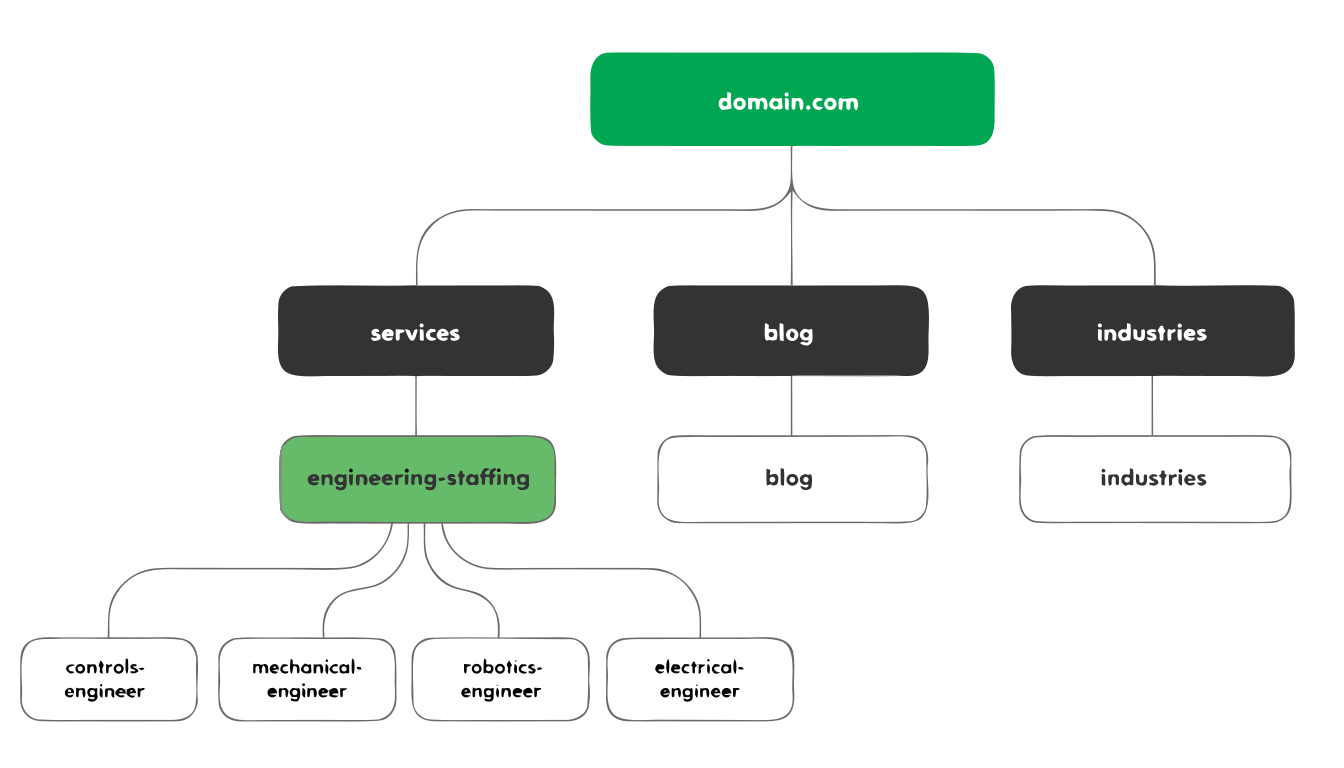
Your URL hierarchy should mirror your content hierarchy. If your engineering staffing pillar lives at /services/engineering-staffing/, your spokes should nest under it:
/services/engineering-staffing/controls-engineer//services/engineering-staffing/mechanical-engineer//services/engineering-staffing/robotics-engineer/
This nesting tells Google (and users) that these pages are related. It creates clean breadcrumbs. It reinforces the parent-child relationship in the URL itself. And it keeps your site organized as it grows.
What you don't want is spokes scattered across random URL paths. If your controls engineer page lives at /blog/controls-engineer-staffing-guide/ while your mechanical engineer page is at /services/mechanical-engineer/ and your robotics page is at /careers/robotics-engineer-jobs/, you've broken the structural signal. Google sees three unrelated pages instead of a coordinated cluster.
When we plan a site architecture for SEO, the URL structure is one of the first things we lock down. Moving URLs later means redirect chains, lost equity, and months of recovery. Get it right before you start building pages.
Internal linking is where the compound effect happens
The URL structure creates the skeleton. Internal linking creates the circulatory system.
Every spoke page should link to its parent pillar. Not buried in a footer or sidebar, but in the body content where it makes contextual sense. A spoke page about mechanical engineer staffing should naturally reference the broader engineering staffing pillar somewhere in its content, with an anchor text that reinforces the pillar's target keyword.
The pillar page should link to every one of its spokes. Again, in context. A section of the engineering staffing pillar that mentions "we place controls engineers, mechanical engineers, and electrical engineers" should link each of those to their respective spoke pages.
Spokes should also link to sibling spokes when the content connects. A page about quality engineers might reference the process engineer page. A page about CNC machinists might link to the tool and die maker page. These lateral links tell Google that all of these pages are part of the same subject cluster.
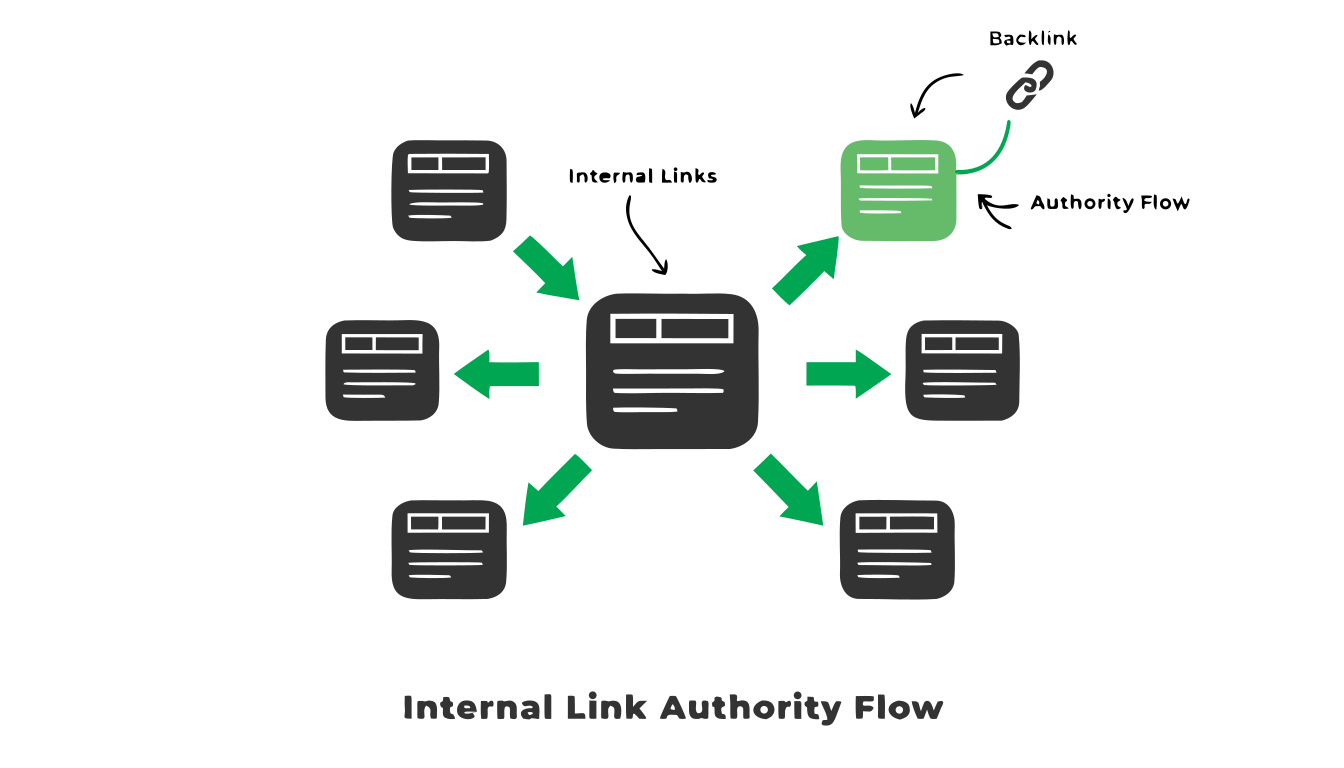
This linking structure creates a web where authority flows between pages. When one spoke earns a backlink from an external site, some of that authority passes through the internal links to the pillar and to other spokes. The whole cluster gets stronger when any single page does.
Compare this to a blog with 50 orphan posts that don't link to each other. One post earns a backlink. That authority stays on that post and doesn't flow anywhere. Nothing compounds.
How to prioritize the build
You probably can't build everything at once. Here's how to decide what goes first.
Start with the pillar closest to revenue. If one service line or product category generates most of your profit, build that cluster first. Get the pillar published, then roll out spokes for it before starting the next pillar. A fully built cluster outperforms two half-built ones.
Prioritize spokes by a combination of search volume, competitive difficulty, and business value. A spoke with 30 monthly searches but strong commercial intent and low competition is a better first build than a spoke with 500 searches and established competitors dominating page one.
Set a realistic production pace. Ten pages per month is aggressive but doable for a dedicated team. Two pages per month is more realistic for most businesses handling this internally. Whatever your pace, sequence the work so you complete one cluster before fragmenting your effort across three.
Rewrite existing pages before creating new ones. You probably already have pages that fit into your hub-and-spoke structure. They might just need better content, updated URLs, and intentional internal linking. Don't start from scratch when you can restructure what exists.
Schema markup ties it together for search engines
Each page in your cluster should have appropriate schema markup. The pillar page gets a Service or Organization schema (depending on your business type) plus FAQ schema for any questions it answers. Blog-style spokes get Article or BlogPosting schema. Product or service spokes get Service schema.
The schema doesn't directly drive the hub-and-spoke relationship, but it reinforces what each page is about and helps Google understand the content type. When combined with clean URL structure and strong internal linking, it rounds out the technical signals.
What this looks like after 6 months
We've seen this pattern play out consistently. A site that builds one full cluster (pillar plus 8-12 spokes) and gives it 4-6 months to index and accumulate signals typically sees the pillar page start ranking for broader terms while the spokes capture long-tail variations. The overall organic footprint for that topic area grows faster than if the same number of pages had been published as disconnected blog posts.
The compounding effect is real. As the cluster matures, new content added to it benefits from the existing internal links and topical signals. Spoke #12 ranks faster than spoke #1 did because it's joining an established cluster instead of starting from nothing.
This is also where the strategy connects to demand generation. Your hub-and-spoke content captures demand from people searching for specific topics. But the depth of your content also generates demand by positioning your brand as the authority on a subject. People who find one useful page are more likely to explore the cluster, and that builds trust before they ever reach out.
The mistake most businesses make
They skip the planning. They don't map the pillars and spokes before they start writing. They publish content reactively, based on whatever topic someone suggested in a meeting, and end up with a blog that's a mile wide and an inch deep on every subject.
If your blog has 50 posts but no single topic is covered by more than two or three of them, you don't have a content strategy. You have a content pile. And Google treats it accordingly.
The fix isn't complicated, but it does require discipline: pick your topics, plan the structure, map the URLs, and build it out systematically. If that process feels overwhelming or you're not sure where to start, schedule a consult with our team. We'll look at your existing content, identify the clusters worth building, and put together a production plan that actually moves your rankings.
