


You turned on Target ROAS or Target CPA because someone told you it was the "smart" move. Maybe it was Google's recommendation engine. Maybe it was your agency. Maybe you read it in a blog post (ironic, I know).
And on paper, it makes sense. Why would you not want Google to automatically optimize your bids for the best return?
Here's the problem: if your conversion tracking isn't set up correctly — or isn't set up at all — you just handed the algorithm a blindfold and a steering wheel. It's going to drive with absolute confidence. It's just not going to drive anywhere good.
This is one of the most common and most damaging setups we see when auditing ecommerce Google Ads accounts. And the worst part? It doesn't just waste your budget today. It compounds. The longer it runs, the worse it gets.
This article is for business owners who are either running their own Google Ads or working with an agency and want to understand whether their bidding strategy is actually set up to succeed — or quietly bleeding money.
Let's break it down.
What Is Value-Based Bidding in Google Ads?
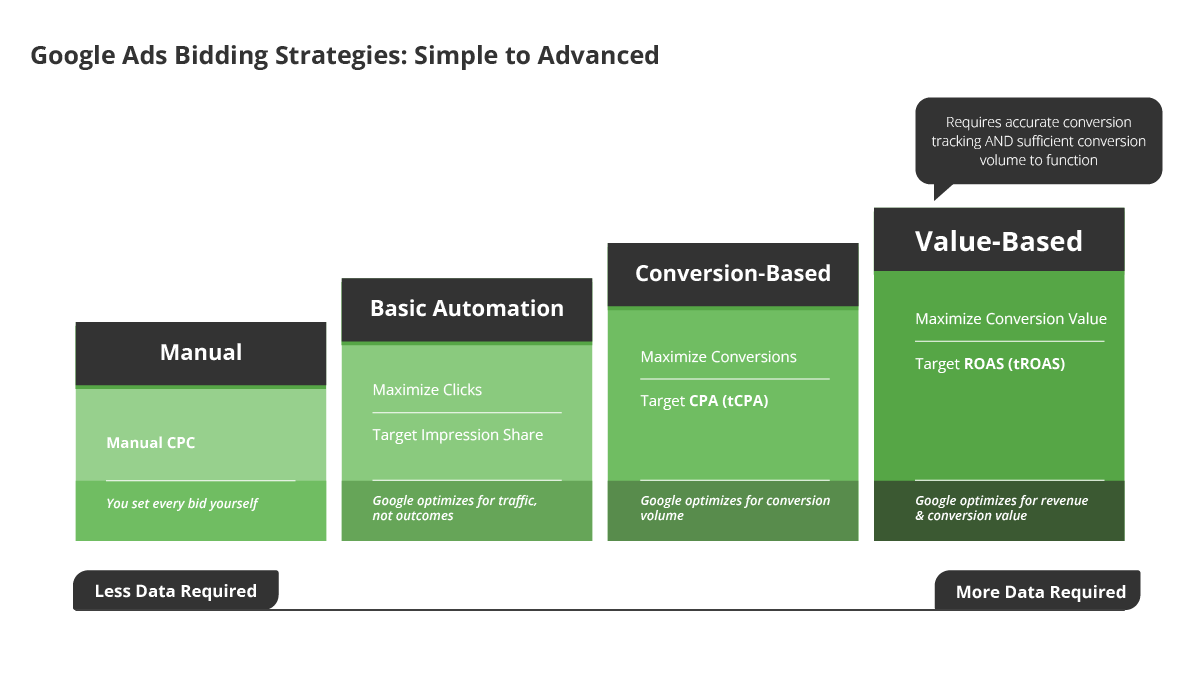
Value-based bidding is a category of automated bid strategies in Google Ads where the algorithm adjusts your bids in real time based on the value of each potential conversion. The most common value-based strategies are Target ROAS (tROAS), Target CPA (tCPA), and Maximize Conversion Value.
In plain English: Instead of you manually setting how much to bid on each keyword or audience, you're telling Google, "Here's the outcome I want — go figure out the best way to get there."
This is different from simpler strategies like Manual CPC (where you set every bid yourself) or Maximize Clicks (where Google just tries to get you as many clicks as possible without caring what happens after the click).
Value-based bidding sits at the top of the complexity scale. It's the most automated, the most "hands-off," and — when it works — the most powerful. Google pushes these strategies hard because, in the right conditions, they genuinely outperform manual bidding. The algorithm can process thousands of signals in real time that no human could ever account for.
But here's the part Google glosses over: these strategies are entirely dependent on the data you feed them. The algorithm doesn't know what a "good" outcome is on its own. It only knows what you tell it through your conversion tracking. If that data is wrong, incomplete, or missing entirely, the algorithm doesn't stop and ask questions. It just optimizes toward whatever signal it has — even if that signal is garbage.
What Does Conversion Tracking Actually Do (And Why Does It Matter)?
Let's get this out of the way: a lot of business owners don't fully understand what conversion tracking is. That's not a knock — it's just not something most people have a reason to think about until their ad spend starts underperforming.
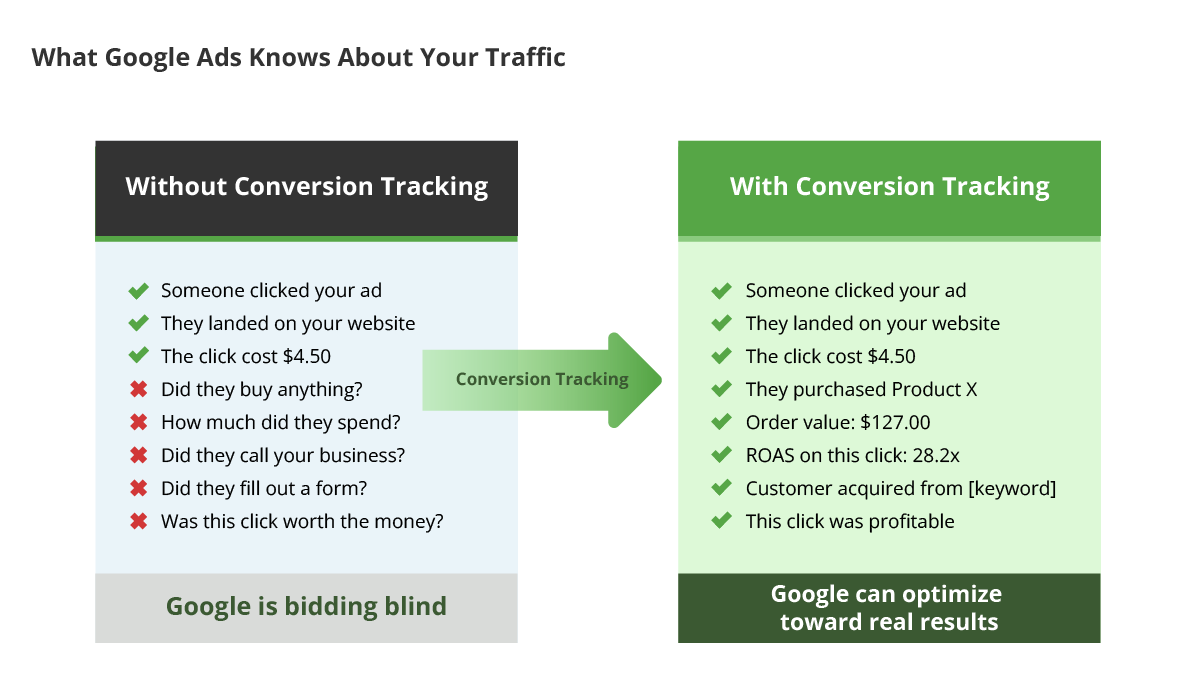
Conversion tracking is the mechanism that tells Google Ads what happened after someone clicked your ad. Did they buy something? Fill out a form? Call your business? Add something to their cart? And critically — how much was that action worth?
Without conversion tracking, Google Ads knows that someone clicked your ad and landed on your website. That's it. It has no idea if that click turned into a $500 sale, a junk lead, or someone who bounced in three seconds. It's flying completely blind on outcomes.
There are different ways to set up conversion tracking — a Google tag on your website, importing goals from Google Analytics 4, feeding in offline conversion data from your CRM — but the method matters less than the outcome. For a deeper dive on how to connect your ad data to actual revenue, check out our guide on closed-loop lead tracking. What matters is this:
Conversion data is the only input Smart Bidding uses to make decisions.
Read that again. Every bid the algorithm makes, every optimization it runs, every decision about who to show your ads to and how much to pay for the click — it all comes back to your conversion data. If that data is accurate, the algorithm gets smarter over time. If that data is wrong, the algorithm gets confidently, aggressively worse.
What Happens When You Use Smart Bidding With Bad or No Conversion Data
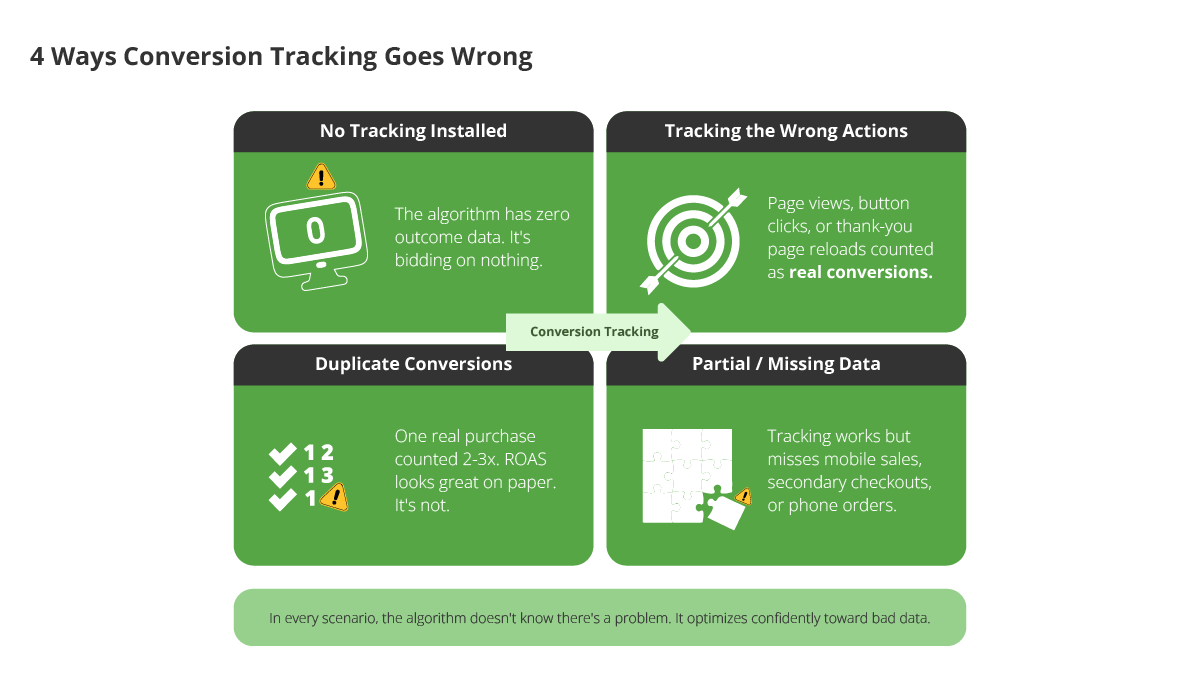
This is where things go sideways. And it's not hypothetical — we see this in almost every ecommerce account we audit. Here are the four most common scenarios.
Scenario 1: No Conversion Tracking At All
This is the most obvious problem, but it still happens more often than you'd think. The account is running Target ROAS or Target CPA, but there's no conversion tracking installed. Or it was installed once and broke during a site update, and nobody noticed.
In this case, the algorithm has literally zero outcome data. It doesn't know if your ads are generating sales or setting money on fire. It's placing bids based on... nothing meaningful. It might as well be random.
Scenario 2: Tracking the Wrong Conversions
This one is sneaky. The account has conversion tracking, but it's measuring the wrong things. Page views are being counted as conversions. Button clicks that don't lead anywhere are being counted. A "thank you" page fires a conversion every time it loads — including when someone refreshes the page or hits the back button.
The algorithm sees these and thinks it's winning. "Great, we're getting tons of conversions! Let me double down on this strategy." Except none of those "conversions" are actual sales or leads.
Scenario 3: Duplicate or Inflated Conversions
You've got Google Ads tracking and Google Analytics tracking and maybe a third-party pixel, and they're all firing on the same event. One real purchase gets counted as three conversions. Your ROAS looks incredible on paper. In reality, it's a third of what's being reported.
The algorithm is now optimizing based on 3x inflated data. It thinks it's performing three times better than it is, which means it's making bidding decisions that are wildly disconnected from reality.
Scenario 4: Partial or Missing Conversions
Your conversion tracking works, but it only catches some of your sales. Maybe it tracks desktop purchases but misses mobile. Maybe it fires on your main product page but not your secondary checkout flow. You're getting real data — just not all of it.
This is arguably the most frustrating scenario because everything looks like it's working. But the algorithm is making optimization decisions based on an incomplete picture, which means it's consistently undervaluing certain traffic, audiences, or keywords that are actually performing well.
The Common Thread
In every one of these scenarios, the algorithm doesn't know it has a problem. It's not going to flag an error or pause your campaigns. It's going to optimize with full confidence toward whatever data it's receiving — even if that data is completely wrong.
That's the core issue. Smart Bidding isn't "smart" in the way most people think. It's a machine learning system that does exactly what you tell it to do. If you tell it the wrong things, it does the wrong things — efficiently, at scale, and with your money.
The Compounding Effect: Why Bad Data Gets Worse Over Time
This is the part most people miss, and it's the most important concept in this entire article.
When you first turn on a Smart Bidding strategy, the algorithm enters a "learning period." During this time — usually one to two weeks — it's gathering data, testing different bid levels, and trying to figure out the best approach for your account. Think of it as calibration.
Here's the problem: if the data it's learning from is wrong, it's not calibrating. It's miscalibrating. And once it's miscalibrated, every decision it makes going forward is based on a flawed foundation.
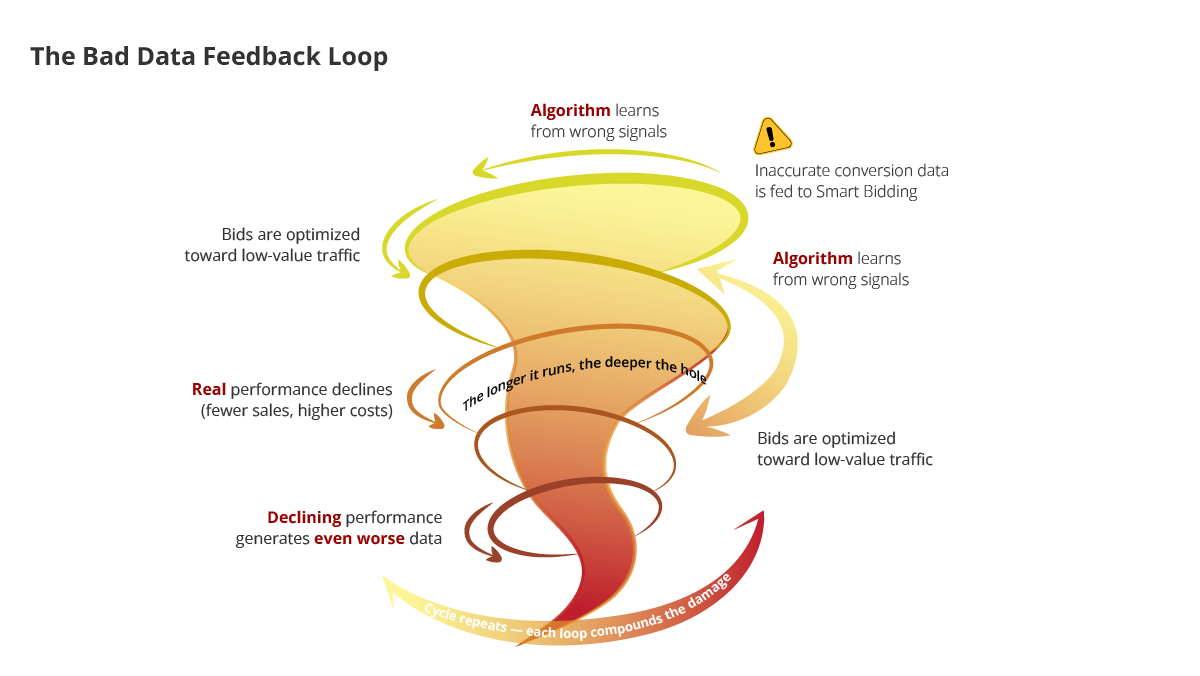
This creates a feedback loop that most people don't realize is happening:
- Bad data goes in → The algorithm learns from inaccurate conversion information.
- Bad optimization comes out → It starts prioritizing the wrong audiences, keywords, and placements.
- Results get worse → Real performance declines because the algorithm is chasing the wrong signals.
- Even worse data goes in → The declining performance generates new data that's even further from reality.
- The cycle repeats → Each loop compounds the error.
This isn't a one-time mistake that levels off. It's a cycle that accelerates. The longer bad data feeds the algorithm, the deeper the hole gets. After a few months of this, the account's performance baseline has shifted so far that even fixing the tracking doesn't immediately fix the problem. The algorithm needs to essentially re-learn from scratch.
Think of it like giving someone wrong directions, and every time they make a wrong turn, they ask for new directions — but they're asking someone who's also lost. Each new set of directions takes them further from where they need to be.
This is why you can't just "wait it out" or hope the algorithm figures it out on its own. It won't. It's going to keep optimizing confidently in the wrong direction until you intervene.
Minimum Conversion Volume: The Requirement Nobody Talks About
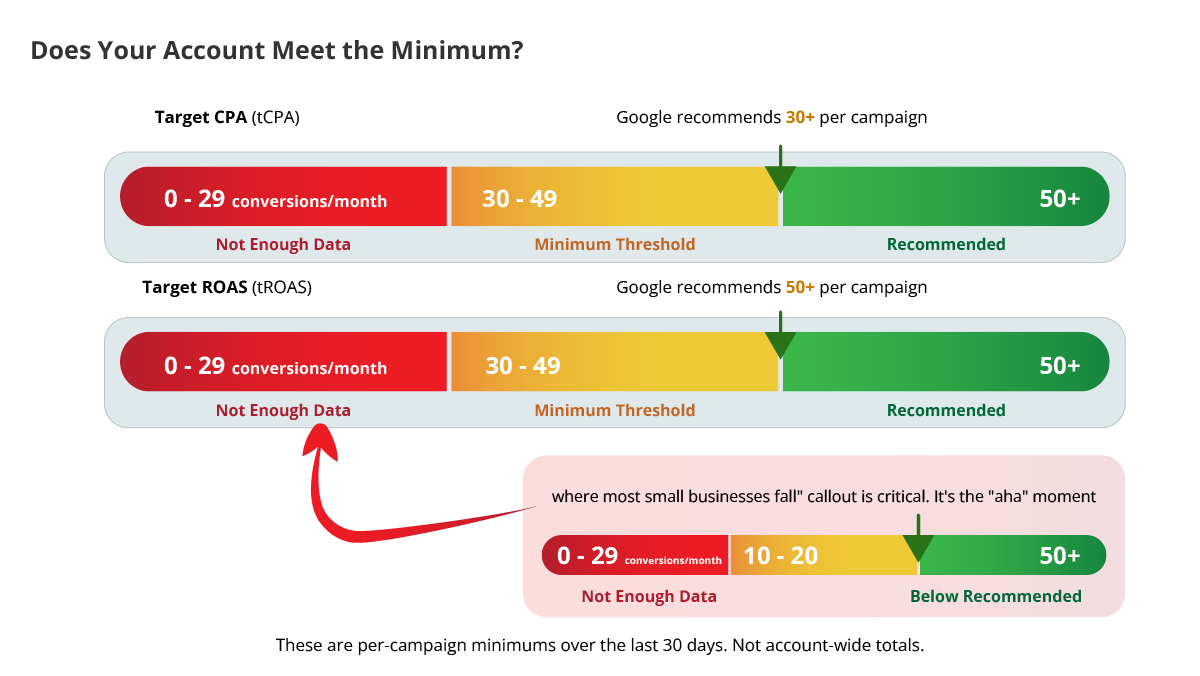
Even if your conversion tracking is perfect — every sale captured, every value accurate — there's a second requirement that most advertisers either don't know about or choose to ignore.
Smart Bidding strategies require a minimum volume of conversions to function properly.
Google's own documentation recommends at least 30 to 50 conversions per campaign in the last 30 days for Target CPA to work effectively. For Target ROAS, that number is 50 or more. These aren't suggestions. They're functional requirements. Below these thresholds, the algorithm doesn't have enough data points to identify patterns, and its decisions become erratic.
Here's the uncomfortable truth: most small and mid-size ecommerce accounts don't hit these numbers on a per-campaign basis. If you're spending $2,000 to $5,000 a month and splitting that across four or five campaigns, the math often doesn't work. You might be getting 15 to 20 conversions per campaign per month — which isn't enough for the algorithm to reliably optimize.
What happens when you use Smart Bidding below the minimum volume threshold? Your performance swings wildly week to week. Your CPA might be $30 one week and $120 the next with no clear explanation. The algorithm is essentially guessing, reacting to statistical noise instead of real patterns.
Not every account is ready for value-based bidding, and that's completely okay. A well-managed manual or semi-automated bidding strategy on a smaller account will almost always outperform a Smart Bidding strategy that doesn't have enough data to work with. This isn't a failure — it's just matching your strategy to your reality.
How to Tell If Your Account Has This Problem
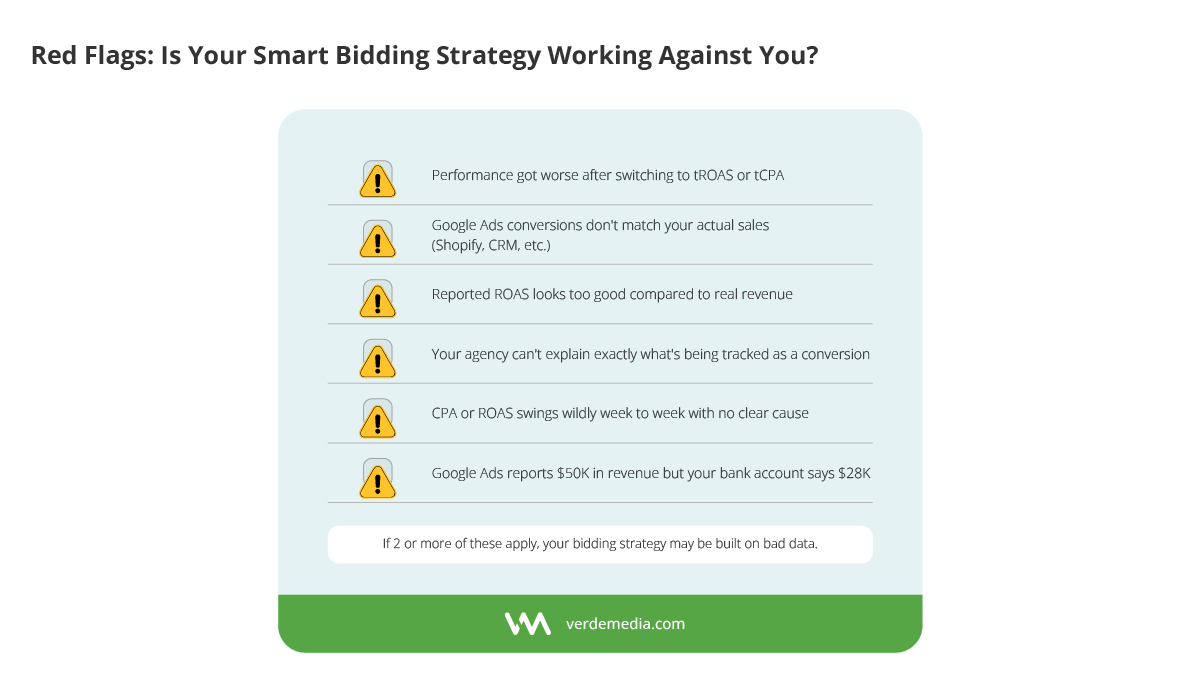
If you're running Smart Bidding and things feel "off" but you're not sure why, here are the red flags to look for. You don't need to be a Google Ads expert to spot most of these.
Your performance got worse after switching to tROAS or tCPA. This is the most obvious signal. If you moved to a Smart Bidding strategy and your cost per acquisition went up, your return on ad spend went down, or your lead volume dropped, the algorithm may be working against you rather than for you.
Your reported conversions don't match your actual sales or leads. Pull up your Google Ads conversion data and compare it to what your Shopify dashboard, CRM, or bank account actually shows. If Google says you got 100 conversions last month but you only had 40 real sales, something is very wrong with your tracking.
Your conversion numbers look "too good." If your Google Ads account is reporting a 10x ROAS and your business doesn't feel like it's printing money, the numbers are probably inflated. Duplicate tracking, misconfigured events, and over-counted conversions all create this illusion.
Your agency can't clearly explain what's being tracked and how. This is a big one. If you ask your agency "what actions are we counting as conversions?" and they can't give you a clear, specific, immediate answer, that's a problem. This isn't an obscure technical detail — it's the foundation of your entire strategy.
Your CPA or ROAS fluctuates wildly week to week. Some variation is normal. But if your cost per acquisition doubles one week, drops the next, and triples the week after, the algorithm is likely operating without enough data to stabilize.
Google Ads and your actual platform show completely different numbers. If Google Ads says you made $50,000 in revenue last month and Shopify says $28,000, you have a conversion tracking accuracy problem that's directly affecting every bid the algorithm makes.
If any of these sound familiar, it doesn't mean your account is beyond saving. But it does mean you have a foundational issue that needs to be fixed before any bid strategy optimization is going to matter.
What to Do About It: Fixing the Foundation Before the Strategy

If you've read this far and you're concerned about your account, here's the path forward. The order matters — don't skip steps.
Step 1: Audit Your Conversion Tracking
Before you touch anything else, figure out what your account is actually tracking. What actions are counted as conversions? Are the values accurate? Are there duplicates? Are conversions firing consistently or intermittently?
If you're not technical enough to do this yourself, this is a worthwhile investment to have someone audit. We put together a 30-minute Google Ads conversion tracking audit guide that walks you through the process step by step. A conversion tracking audit is one of the highest-ROI things you can do for your Google Ads account because everything else depends on it.
Step 2: Fix or Rebuild Your Tracking
Once you know what's broken, fix it. This might mean removing duplicate conversion actions, reconfiguring your Google tag, setting up proper ecommerce tracking through GA4, or implementing server-side tracking for more accuracy.
The goal is simple: every real conversion gets counted once, with the correct value, and nothing else gets counted.
Step 3: Drop Back to a Simpler Bidding Strategy While Data Accumulates
This is the step most people resist, but it's critical. After you fix your tracking, you need to give the algorithm clean data to learn from. That means pausing your tROAS or tCPA strategy and moving to something simpler — Manual CPC, Maximize Clicks with a bid cap, or even Maximize Conversions without a target.
This isn't a step backward. It's a reset. You're letting accurate data build up so that when you do move back to value-based bidding, the algorithm has a reliable foundation to work from.
Step 4: Graduate to Smart Bidding Only When You're Ready
"Ready" means two things: your conversion tracking is accurate and verified, and you have enough conversion volume to meet Google's minimum thresholds. If you have clean tracking but only 15 conversions per campaign per month, you're still not ready for tROAS. Be honest with yourself about where your account actually is.
Step 5: Monitor the Feedback Loop Continuously
Even after you make the switch, this isn't a "set it and forget it" situation. Regularly check that your tracked conversions match your actual business outcomes. Site updates, platform changes, tag manager modifications — any of these can break your tracking without warning. Build a habit of checking monthly at minimum.
When to Get Help
Conversion tracking and bid strategy are probably the two areas where working with a competent agency or specialist pays for itself the fastest. If you're not sure what you're looking at or how to fix it, this is the right time to bring in help. Just make sure whoever you bring in can clearly explain what they're doing and why — if they can't, keep looking.
Questions to Ask Your Agency About Your Bidding Strategy
If you're working with an agency, you have every right to understand what's happening in your account. You're paying for it. These five questions will tell you very quickly whether your bidding strategy is built on a solid foundation or a house of cards.
1. "What bid strategy are we using, and why did you choose it?"
A good answer is specific and tied to your account's data. "We're using Target CPA because your account consistently generates 40-plus conversions per campaign per month and your tracking is verified against your Shopify data."
A red-flag answer is vague or defaulted. "We're using what Google recommends." That's not a strategy — that's auto-pilot.
2. "How many conversions per month is each campaign generating?"
A good answer is an actual number, pulled from the account. If your campaigns are below 30 to 50 conversions per month and you're on tCPA or tROAS, follow up with: "Is that enough for this strategy to work?"
A red-flag answer is "I'd have to check" followed by silence, or a deflection about how the algorithm will figure it out.
3. "What exactly are we tracking as a conversion?"
A good answer lists specific actions: purchases, form submissions, phone calls — with clarity on how each is being tracked.
A red-flag answer is vague: "We're tracking conversions." That doesn't tell you anything.
4. "Can you show me that our tracked conversions match our actual sales?"
A good answer involves pulling up both Google Ads data and your actual business data (Shopify, CRM, whatever applies) and comparing them. They should be close — not identical, but close.
A red-flag answer is resistance to the comparison or dismissing the discrepancy as "normal."
5. "Do we meet Google's recommended minimum conversion thresholds for this bid strategy?"
A good answer is either "yes, here's the data" or "no, and here's why we're using a different approach." Both are fine. What's not fine is using tROAS on a campaign with 12 conversions a month and pretending that's going to work.
These aren't trick questions. They're basic accountability questions that any competent agency should be able to answer confidently and clearly. If asking these questions creates tension with your agency, that tells you something important.
Frequently Asked Questions About Value-Based Bidding
What is value-based bidding in Google Ads?
Value-based bidding is a category of automated bid strategies — including Target ROAS, Target CPA, and Maximize Conversion Value — where Google's algorithm automatically adjusts your bids based on the predicted value of each conversion. It uses your conversion tracking data to decide how much to bid on every auction in real time.
Does Target ROAS need conversion tracking to work?
Yes. Target ROAS (tROAS) relies entirely on your conversion data — specifically, the conversion values you're reporting — to make bidding decisions. Without accurate conversion tracking and correct values, the algorithm has no reliable signal to optimize toward and will make increasingly poor bidding decisions.
How many conversions does Smart Bidding need?
Google recommends a minimum of 30 to 50 conversions per campaign in the last 30 days for Target CPA, and 50 or more for Target ROAS. Below these thresholds, the algorithm doesn't have enough data to identify meaningful patterns and your performance will be inconsistent.
What happens if my Google Ads conversion tracking is wrong?
If your conversion tracking is inaccurate — whether it's over-counting, under-counting, or tracking the wrong actions — Smart Bidding will optimize based on that flawed data. This creates a compounding problem: bad data leads to bad optimization, which leads to worse performance, which generates even worse data. The longer it runs, the more damage it does.
Can I use Smart Bidding with a small budget?
You can, but you may not meet the minimum conversion volume thresholds needed for strategies like tROAS or tCPA to work effectively. Smaller budgets often perform better with simpler strategies like Manual CPC or Maximize Clicks until enough conversion data accumulates to support value-based bidding.
How do I know if my agency is using the right bid strategy?
Ask your agency what bid strategy they're using and why, how many conversions each campaign generates monthly, what's being tracked as a conversion, and whether your tracked conversions match your actual sales. A competent agency should be able to answer these questions clearly and back them up with data.
The Bottom Line
Value-based bidding strategies like Target ROAS and Target CPA are genuinely powerful tools. When they're built on accurate conversion data and sufficient volume, they can outperform manual bidding significantly. That part is real.
But they are tools, not strategies. And a tool only works when the conditions are right.
Running value-based bidding without accurate conversion tracking is like turning on cruise control in a car with a broken speedometer. The system is going to regulate something — it's just not going to be your actual speed. And the longer you let it run, the further off course you end up.
If you're not sure whether your conversion tracking is set up correctly, that's the single most important thing to figure out — before your bid strategy, before your ad copy, before your keyword targeting, before anything else in your account. Because if the data is wrong, everything built on top of it is wrong too.
Fix the foundation first. Everything else follows. And if you want a second set of eyes on your account, we're happy to take a look.
